Five Foolish Food Policies


6th November 2010

The Carbon Sense Coalition today accused western politicians of creating a food crisis with foolish food policies.

The Chairman of “Carbon Sense”, Mr Viv Forbes, said that climate alarmism and green extremism was being used to remove farmland from food production and deny fishermen access to oceans.
(more…)


2009 International Conference on Climate Change


Hearland 2009

The proceedings of the second International Conference on Climate Change in New York will become available here: http://www.heartland.org/events/NewYork09/proceedings.html.

Czech Republic President Vaclav Klaus’ speech is on-line here:
http://www.klaus.cz/klaus2/asp/clanek.asp?id=oWwyM2CjH0OG

A PDF version is here. [101 KB].

Several people have reports on the event:

Maggie Thauerskold: http://www.theclimatescam.com

Bob Carter: http://www.quadrant.org.au/blogs/doomed-planet/2009/03/bob-carter-at-heartland-2

Jennifer Marohasy: http://jennifermarohasy.com/blog/


Concerned Household Electricity Consumers Council Press Release


PRESS RELEASE

The Concerned Household Electricity Consumers Council in its Comment Calls on President Trump and EPA to Repeal and Not Replace the Clean Power Plan(CPP).
CHECC CPP ANPRM Replacement Comment Overview FINAL 022718 PDF

 Key Comment Conclusions*: 

  • CO2 is a Beneficial Gas, not a Pollutant. As a result, the Social Cost of Carbon is Negative since CO2 is so very critical to plant growth and therefore human life.

  • The 2009 Endangerment Finding must be reconsidered and rescinded/vacated. Thus, the CPP would not be replaced.

  • All future Federal, State and private sector decisions regarding the Nation’s electric power grid must focus solely on minimizing consumer electricity prices as well as maximizing Grid Reliability and Resilience. No consumer electricity price increases should be permitted by regulators that result from increased Renewables/Energy Storage Grid penetration.

  • The Current Reconsideration of future vehicle MPG Standards must treat CO2 reduction as a cost, not a benefit, so that only consumer preferences matter, not climate change issues. Currently, with low gasoline price expectations, most consumers prefer trucks & SUVs.

*Based on the Concerned Household Electricity Consumers Council (CHECC) Comment in response to EPA’s ANPRM CPP Replacement

CHECC CPP ANPRM Replacement Comment FINAL to EPA 022618 (1)

Filed February 26, 2018

(more…)


Fix the Budget by Cutting Climate Waste


Media Statement by Viv Forbes

Chairman, The Carbon Sense Coalition.

Any quotes taken directly from this statement may be attributed to Mr Forbes

The Carbon Sense Coalition today called on the federal government to reduce the burden of the Climate Industry on all taxpayers and consumers.

The Chairman of Carbon Sense, Mr Viv Forbes, said that the biggest national scandal today was how the whole government apparatus, including the nationalised research and media industries and parts of the opposition, was totally captive to a religious belief that a destructive war on carbon energy will somehow provide benefits to some future generation of Australians by cooling the climate and preventing extreme weather events.

“This is a delusion.”

Quote:

It was the great Milton Friedman who said “There is only one tax on the people and that is government spending”.

Cutting expenditure, not re-arranging expenditure, must be the total focus of this budget.

And the first candidate for spending cuts must be the totally useless Climate Change Industry.

Every department, program, research grant, travel grant or salary with climate, warming, carbon, sustainability, renewable, sequestration, clean coal, ethanol or IPCC in its title or mission statement should be abolished forthwith together with its staffing. This list must include but not be restricted to:

The Australian Renewable Energy Agency (Arena) and its dependants, saving about $3.2 billion.

The Clean Energy Finance Corporation, saving about $10 billion.

The Emerging Renewables Program, saving about $126 million.

The Clean Technology Innovation Program, saving about $200 million.

Subsidies to Coal-fired electricity generators, saving about $5.5 billion. (This has to be the ultimate madness – the government levies a crippling carbon tax on coal-fired electricity generation to force them to close and then pays huge subsidies to the same generators to delay their closure).

All Climate Change “Research” focussed on carbon dioxide, saving about $300 million.

“Contracts for Closure” – payments to ensure closure of some electricity generators (unbelievable – surely the carbon tax will do this).

The Coal Sector Jobs Package – payments to coal mines to offset the cost of the carbon tax- just abolish the tax.

Coal Sector Assistance Package – Subsidies to some Coal Mines (another stupidity – repaying some of the carbon tax they took in the first place).

Everything funded under the Clean Energy Future Plan.

All renewable energy subsidies.

The Low Emissions Technology Demonstration Fund.

The Ethanol Production Grants Program – a subsidy per litre of ethanol produced.

All climate change officials, lawyers, inspectors and auditors everywhere, maybe 13,000 of them saving, say, $2 billion per year.

The offices of the Climate Commissioner and the Clean Energy Regulator – whatever they cost is wasted money.

The whole Carbon Capture and Storage empire – The National Low Emissions Coal Initiative, the CCS Flagships Program, the National Carbon Dioxide Infrastructure Plan, and the Carbon Capture and Storage Institute.

Support for all the International Climate Forums and Conferences via APEC, CEM, G20, IEA, IEF, IPEEC, IRENA, IPCC and all the travel costs associated with attendance.

All handouts under the Green Precincts Fund – $15M spent to date.

All government advertising, market research, media monitoring, media advisers and logo designers promoting the carbon tax, the Department of Climate Change, smart meters or other climate and green energy initiatives.

Donations to Green Friends such as the Climate Institute, the Australian Conservation Council, Climate Works Australia, Green Cross Australia, and the ACTU – $3 million spent already.

To “balance” all of these reduced expenditures the government must also abolish the carbon tax and all fuel taxes not related directly to public road usage and applied to road construction and maintenance.

Note: The above list probably includes errors, double counting and omissions, but such is the confusion and proliferation of the alphabet soup of what poses as “Climate Policy” that it is doubtful if anyone could prepare an accurate and comprehensive list. The only feasible solution is to start cutting, biggest first. None of them will be missed, except with relief by taxpayers and consumers.

Viv Forbes,
Chairman, The Carbon Sense Coalition
www.carbon-sense.com
Rosewood Qld Australia
forbes@carbon-sense.com


Germany’s Grand Plan to Abolish Carbon Fuels Fails


Germany’s Energiewende – Lessons for Australia from Germany

In March 2017, the German Federal Ministry of Economics and Energy published a brochure announcing that the Energiewende, its renewable energy revolution, was ‘a success story’.

Nothing could be further from the truth.

The Energiewende (Grand Plan) has the goal of making Germany independent of fossil fuels in the long term. Coal, oil and gas were to be phased out, allowing drastic reductions in carbon dioxide emissions. However, these goals have not even begun to be achieved.

The Energiewende was only driven forward in the electricity sector, which, accounts for only one-fifth of energy consumption. There were hardly any successes in the heating/cooling and transport sectors.

And so carbon dioxide emissions in Germany have been rising since 2009, even though well over a hundred billion euros have been spent on the expansion of solar and wind energy over the same period. The financial obligations undertaken in the process will continue to burden taxpayers for another two decades and will end up costing German consumers a total sum of around 550 billion euros.

Despite this enormous effort, security of supply is increasingly under threat. At the same time, people and the biosphere are suffering; wildlife protection has become subordinated to climate mitigation, even though the possibility of achieving the goals of reducing carbon dioxide emissions is becoming increasingly distant and the measures for the energy transition seem to become more and more questionable from a constitutional point of view.

800 regional associations in Germany commissioned a report on the achievements of the Grand Plan, supported by 24 German experts in all relevant fields.

“In this review we would like to inform a public debate and set out a reasonable course for energy policy in Germany.”

It details stark lessons for Australia. They have produced a very clear readable summary of all aspects of the German electricity disaster.

Read more: http://carbon-sense.com/wp-content/uploads/2018/08/1-6-_kompendium-der-energiewende_englisch_1.pdf [PDF, 2.7 MB]

Source: https://www.vernunftkraft.de/


Climate of Confusion


By Keith Orchison

By coincidence I have come across the new “Climate of the Nation” report from the strongly green-leaning Climate Institute on the same day I have been reading the latest Essential Report polling and just after looking at a pre-dawn snapshot of east coast market capacity on a pretty standard winter’s day.

Taking the latter first, at 6.30am today 97.6 per cent of the New South Wales load was being met by black coal generation as the State’s population was getting up and its substantial factory sector was gearing up. If you take NSW, Victoria and Queensland together – they represent 90 per cent of the east coast market – at this point 88.9 per cent of the three-State load was being met by brown and black coal generation with wind power providing 0.4 per cent and solar (naturally as the sun wasn’t yet up) 0.04 per cent.

(Eight hours later, I see, at 2.30pm, black coal generation is still bearing 89.7 per cent of NSW load and coal is accounting for almost 82 per cent of required capacity in the three largest States of the market – with hydro power providing 7.5 per cent and wind/solar 4.3 per cent.)

The question that comes to my mind when I look at data like this is what would be required to replace even half this coal power (let alone all of it) with mostly wind power and solar PVs? What would the total system cost be in a set-up where supply is assured and how would this translate in to retail bills?
(more…)


Our Glaciers are Growing, not Melting – More Falsehoods from Al Gore


By Robert W. Felix

8 Mar 10 – “Almost all of the ice-covered regions of the Earth are melting — and seas are rising,” said Al Gore in an op-ed piece in the New York Times on February 27.

Both parts of Gore’s statement are false.

Never mind that Mr. Gore makes only passing reference to the IPCC’s fraudulent claims that the Himalayan glaciers will all melt by 2035. (“A flawed overestimate,” he explains.)

Never mind that Mr. Gore dismisses the IPCC’s fraudulent claims that the oceans are rising precipitously. (“Partly inaccurate,” he huffs.)

Never mind that Mr. Gore completely ignores the admission by the CRU’s disgraced former director Phil Jones that global temperatures have essentially remained unchanged for the past 15 years.

I’ll let someone else dissect Gore’s lawyering comments, and concentrate on just the one sentence about melting ice, because neither part of that sentence is true.

Contrary to Gore’s assertions, almost all of the ice-covered regions of the Earth are growing, not melting — and the seas are not rising.

Let’s look at the facts.

If you click on the words “are melting” in Gore’s article, you’re taken to a paper by Michael Zemp at the University of Zurich. Mr. Zemp begins his paper by warning that “glaciers around the globe continue to melt at high rates.”

However, if you bother to actually read the paper, you learn that Zemp’s conclusion is based on measurements of “more than 80 glaciers.”

Considering that the Himalayas boast more than 15,000 glaciers, a study of “more than 80 glaciers” hardly seems sufficient to warrant such a catastrophic pronouncement.

Especially when you learn that of those 80 glaciers, several are growing.

Growing. Not melting.

“In Norway, many maritime glaciers were able to gain mass,” Zemp concedes. (“Able to gain mass” means growing.)

In North America, Zemp also concedes, “some positive values were reported from the North Cascade Mountains and the Juneau Ice Field.”  (“Displaying positive values” means growing.)

Remember, we’re still coming out of the last ice age. Ice is supposed to melt as we come out of an ice age. The ice has been melting for 11,000 years. Why should today be any different?
I’m guessing that most Canadians and Northern Europeans are very happy that the ice has been melting.

Unfortunately, that millenniums-long melting trend now appears to be changing. No matter how assiduously Mr. Gore tries to ignore it, almost all of the ice-covered regions of the Earth are now gaining mass. (Or, displaying positive values, if you will.)

For starters, let’s look at those Himalayan glaciers. In a great article, entitled “World misled over Himalayan glacier meltdown,” Jonathan Leake and Chris Hastings show that the IPCC’s fraudulent claims were based on “speculation” and “not supported by any formal research.”

As a matter of fact, many Himalayan glaciers are growing. In a defiant act of political incorrectness, some 230 glaciers in the western Himalayas – including Mount Everest, K2 and Nanga Parbat – are actually growing.

“These are the biggest mid-latitude glaciers in the world,” says John Shroder of the University of Nebraska-Omaha. “And all of them are either holding still, or advancing.”

And get this. Eighty seven of the glaciers have surged forward since the 1960s.

So much for Mr. Gore’s “more than 80 glaciers.”

(I don’t know how many Himalayan glaciers are being monitored, but my guess would be fewer than a thousand, so it’s possible that hundreds more are growing. There aren’t enough glaciologists in the world to monitor them all.)

But we don’t need to look to the Himalayas for growing glaciers. Glaciers are growing in the United States.

Yes, glaciers are growing in the United States.

Look at Washington State. The Nisqually Glacier on Mt. Rainier is growing. The Emmons Glacier on Mt. Rainier is growing. Glaciers on Glacier Peak in northern Washington are growing. And Crater Glacier on Mt. Saint Helens is now larger than it was before the 1980 eruption. (I don’t think all of the glaciers in Washington or Alaska are being monitored either.)

Or look at California. All seven glaciers on California’s Mount Shasta are growing. This includes three-mile-long Whitney glacier, the state’s largest. Three of Mount Shasta’s glaciers have doubled in size since 1950.

Or look at Alaska. Glaciers are growing in Alaska for the first time in 250 years. In May of last year, Alaska’s Hubbard Glacier was advancing at the rate of seven feet (two meters) per day – more than half-a-mile per year. And in Icy Bay, at least three glaciers advanced a third of a mile (one-half kilometer) in one year.

Oh, by the way. The Juneau Icefield, with its “positive values,” covers 1,505 square miles (3,900 sq km) and is the fifth-largest ice field in the Western Hemisphere. Rather interesting to know that Gore’s own source admits that the fifth-largest ice field in the Western Hemisphere is growing, don’t you think?

But this mere handful of growing glaciers is just an anomaly, the erstwhile Mr. Gore would have you believe.

Well, let’s look at a few other countries.

  • Perito Moreno Glacier, the largest glacier in Argentina, is growing.
  • Pio XI Glacier, the largest glacier in Chile, is growing.
  • Glaciers are growing on Mt. Logan, the tallest mountain in Canada.
  • Glaciers are growing on Mt. Blanc, the tallest mountain in France.
  • Glaciers are growing in Norway, says the Norwegian Water Resources and Energy Directorate (NVE).
  • And the last time I checked, all 50 glaciers in New Zealand were growing.

But this is nothing. These glaciers are babies when you look at our planet’s largest ice masses, namely, the Antarctic and Greenland ice sheets.

Contrary to what you may have heard, both of those huge ice sheets are growing.

In 2007, Antarctica set a new record for most ice extent since 1979, says meteorologist Joe D’Aleo. While the Antarctic Peninsula area has warmed in recent years, and ice near it diminished during the summer, the interior of Antarctica has been colder and the ice extent greater.

Antarctic sea ice is also increasing. According to Australian Antarctic Division glaciology program head Ian Allison, sea ice losses in west Antarctica over the past 30 years have been more than offset by increases in the Ross Sea region, just one sector of east Antarctica.

The Antarctic Peninsula, where the ice has been melting, is only about 1/50th the size of east Antarctica, where the ice has been growing. Saying that all of Antarctica is melting is like looking at the climate of Oregon and saying that this applies to the entire United States.

There was not any evidence of significant change in the mass of ice shelves in east Antarctica nor any indication that its ice cap was melting, says Dr. Allison. “The only significant calvings in Antarctica have been in the west.” And he cautioned that calvings of the magnitude seen recently in west Antarctica might not be unusual.

“A paper to be published soon by the British Antarctic Survey in the journal Geophysical Research Letters is expected to confirm that over the past 30 years, the area of sea ice around the continent has expanded.”

What about Greenland?

Greenland’s ice-cap has thickened slightly in recent years despite wide predictions of a thaw triggered by global warming, said a team of scientists in October 2005.

The 3,000-meter (9,842-feet) thick ice-cap is a key concern in debates about climate change because a total melt would raise world sea levels by about 7 meters.

But satellite measurements show that more snow is falling and thickening the ice-cap, especially at high altitudes, according to the report in the journal Science.

The overall ice thickness changes are approximately plus 5 cm (1.9 inches) per year or 54 cm (21.26 inches) over 11 years, according to the experts at Norwegian, Russian and U.S. institutes led by Ola Johannessen at the Mohn Sverdrup center for Global Ocean Studies and Operational Oceanography in Norway.

Not overwhelming growth, certainly, but a far cry from the catastrophic melting that we’ve been lead to believe.

Think about that.

The Antarctic Ice Sheet is almost twice as big as the contiguous United States.

Put the Antarctic and Greenland Ice Sheets together, and they’re one hundred times bigger than all of the rest of the world’s glaciers combined.

More than 90 percent of the world’s glaciers are growing, in other words, and all we hear about are the ones that are shrinking.

But if so many of the world’s glaciers are growing, how can sea levels remain the same?

They can’t. The sea level models are wrong.

During the last ice age, sea levels stood some 370 feet (100 meters) lower than today. That’s where all of the moisture came from to create those two-mile-high sheets of ice that covered so much of the north.

And just as the ice has been melting for 11,000 years, so too were sea levels rising during those same years.

But the rising has stopped.

Forget those IPCC claims. Sea levels are not rising, says Dr. Nils-Axel Mörner, one-time expert reviewer for the IPCC.

Dr. Mörner, who received his PhD in geology in 1969, is one of the greatest – if not the greatest – sea level experts in the world today. He has worked with sea level problems for 40 years in areas scattered all over the globe.

“There is no change,” says Mörner. “Sea level is not changing in any way.”

“There is absolutely no sea-level rise in Tuvalo,” Mörner insists. “There is no change here, and there is zero sea-level rise in Bangladesh. If anything, sea levels have lowered in Bangladesh.”

“We do not need to fear sea-level rise,” says Mörner. “(But) we should have a fear of those people who fooled us.”

So there you have it. More falsehoods from Al Gore, the multimillionaire businessman who some say is set to become the world’s first carbon billionaire.

Our glaciers are growing, not melting — and the seas are not rising.

I agree with Dr. Mörner, but I’d make it a tad stronger. We should have a fear of those people who have conned us.

From: www.iceagenow.com/Our_glaciers_are_growing_not_melting.htm


Robert W. Felix is author of Not by Fire but by Ice, and publisher of www.iceagenow.com.


Greenpeace Always Makes a Disaster out of it


By Daniel Wetzel | As of: 18.12.2017

https://www.welt.de/wirtschaft/article171696371/Eine-Katastrophe-macht-immer-erst-Greenpeace-draus.html

[This English version authorised by Patrick Moore.]


“Arguably, the former environmental activist Patrick Moore is difficult to overcome” – Source: Martin U. K. Lengemann

Patrick Moore once helped to found Greenpeace. Today, the ecologist considers the organization an unscientific lobby group. He has a provocative message: carbon dioxide is not poison. It is good for life on the planet.

The week was not bad for the climate protection movement. France’s head of state Emmanuel Macron had summoned the Climate Chancellor Angela Merkel to the summit in Paris and or emerged with the rank of European “Climate President”. And his plan worked out: UN Secretary-General António Guterres urged that he no longer supports fossil fuels because this would amount to an “investment in destruction”. The World Bank announced that it would stop promoting oil and gas production from 2019 onwards.

With so much international involvement in the fight against CO2, the Greens in Paris missed senior German officials. Merkel was represented by Barbara Hendricks (SPD). From the perspective of green climate politician Annalena Baerbock, the Federal Minister for the Environment only completed an “unmotivated courtesy visit”.

Baerbock’s indignation would certainly have been even greater if she had known which alternative program numerous members of the Bundestag of the Union (CDU) and the FDP had preferred to the Paris climate summit. They had followed the invitation of the Federal Association “Liberaler Mittelstand” to a parliamentary breakfast.

There, Canadian Patrick Moore, one of the founding fathers of Greenpeace, presented his view on climate change, CO2 emissions and energy policy, which – if true – would undermine the foundations of official energy and climate policies. For years, Moore has been one of the archenemies of the world’s largest environmental organization, which he had once brought to the baptism. For today’s activist generation he is the fallen angel of environmental protection.

Carbon dioxide increase did not increase temperature
Nuclear power, genetically modified food, forest conservation, chemicals use, climate change – in almost every major environmental issue Moore represents a view that directly contradicts the Greenpeace policy. In doing so, Moore studied biology, biochemistry and forestry, a doctorate in ecology, and was for years the only trained scientist in the Greenpeace leadership.


German carbon dioxide emissions are rather low by international standards – Source: Infographic The World

Good argument is difficult to master. His quarrels with Greenpeace often end at a high level at a stalemate, statement against statement. Everyone claims that his view of things is the truth. This is how it was when Moore presented diagrams of global temperatures and CO2 concentrations of the last 500 million years to a parliamentary breakfast of about 30 members of the Bundestag.

In another chart, the curves derived from the ice cores of the Russian Antarctic station Vostok, provided no evidence, according to Moore, that the CO2 content in the atmosphere had raised the temperature. On the contrary, he explained to the perplexed MPs: “The CO2 value follows the change in temperature, not the other way around.”

Moore does not deny that the CO2 concentration has risen sharply since the beginning of the Industrial Revolution. Nor does he shake the fact of global warming. Only he claims that one has nothing to do with the other. The curves of shark attacks and ice-cream consumption also showed a strong correlation, he reveals. “Correlation does not prove causation.”

The Sun’s activity affects the world climate
According to Moore, there are many complex factors that change the climate. Solar activity is part of it, cloud formation and much more. When the earth’s temperature rises, the oceans “emit” more CO2. A rise in carbon dioxide would be the consequence, not the cause of global warming. The basic assumption of many climate scientists that carbon dioxide is the main trigger of global warming is a “hypothesis” for Moore, nothing more.

“There is no definitive scientific evidence that carbon dioxide is responsible for the slight warming of the global climate that has occurred in the last 300 years – since the Little Ice Age,” says Moore. “Such a proof would have been documented – that’s not the case.”

The objection that 97 percent of all climate scientists attribute CO2 to the role of the greenhouse gas does not impress Moore. He refers to a booklet from 1931. The title: “100 authors against Einstein”. With great numerical superiority, scientists attacked the theory of relativity that a young patent attorney named Albert Einstein had published a few years earlier.

Einstein responded as relaxed as Moore today: “If I was wrong, it would be sufficient for a single author to refute me.” the IPCC of the United Nations, the ultimate judge in matters of climate change, certainly does not impress Moore.

Climate council focuses on human influence
His skepticism derives from the statutes of the IPCC: The committee has the mission to explicitly investigate only the human impact on climate change. For the study of the natural causes of climate change, therefore, the IPCC lacks any mandate. This leads to a conflict of interest: If the UN body finds no human cause of global warming, it loses its right to exist.

In any case, because of its composition, the IPCC does not enjoy the confidence of the former Greenpeace chief. The IPCC was founded by the World Meteorological Organization (WMO) and the United Nations Environment Program (UNEP). According to Moore, “people who care about the weather forecast for the next week” and environmentalists “who focus on daily politics”. That does not indicate competence for the evaluation of the ages of the Earth.

“Why does no one ask geologists, paleontologists, astrophysicists?” After all, the IPCC always expresses only a “concern” about climate change in its progress reports, Moore states. “Greenpeace always makes a disaster out of it”. Since leaving Greenpeace in 1986, Moore repeatedly accuses the environmental organization of unscientific alarmism.
 

Greenpeace has been attracting attention for decades through spectacular actions. Here activists rappel off the cooling tower of the Neurath coal-fired power plant. The slogan: “CO2 kills” – Source: picture alliance / dpa

When Greenpeace was planning a worldwide campaign against the use of chlorine in the 1980s, Moore’s loyalty ended. Chlorine is the eleventh most common element in the earth’s crust, the most important element for public health in human history, and the raw material for countless medicines.

He does not want to force environmental protection at the expense of people. In the environmental organizations, however, the belief has spread that humans are the enemies of the Earth, which he could not support. Moore withdrew himself after 15 years in the Greenpeace peak body. He first became a salmon farmer and then an independent environmental consultant.

He also accepted positions from the nuclear industry and forestry companies in Asia and North America, but he still does not sacrifice his environmental credentials. Although 70, Moore does not expect his crusade against environmental fear mongering is coming to an end anytime soon.

Without CO2, our earth would have long been a dead planet
It annoys him that CO2, the basic building block of all life on earth, is denounced by climate protectors to school classes as a “poison”. Without the gas, Moore said, “our Earth would be a dead planet.”

In the Bundestag he projected graphs on the wall, showing that the CO2 concentration in the atmosphere has been steadily reduced for 150 million years by natural deposition on the seabed and in the earth’s crust.

In primeval times, the amount of carbon dioxide was ten times higher than today’s levels – at the same time there was an explosion of flora and fauna. “Even today, the plants would like to have more CO2,” says Moore, pointing out that “every professional greenhouse farmer fertilizes his plants with CO2 input.”

Concentration approached dangerously low levels
The real drama is not the warming, but the decay of the CO2 concentration in the atmosphere. From more than 4600 parts per million (ppm) it had dropped to barely 180 ppm during the last glaciation. “This is only 30 ppm above the level at which plants begin to die,” says Moore. This was only 18,000 years ago, a geological blink of an eye. It is largely due to the burning of fossil fuels by humans, that the CO2 content has increased again to about 400 ppm today.

If man were to support natural CO2 reduction and ban fossil fuels, “life on earth would be over in less than two million years,” claims Moore. “The fact is that the CO2 concentration in the atmosphere has been dropping to a dangerously low level for a very long time”.

“Human combustion of fossil carbon sources helps restore a balance to the global carbon cycle,” says Moore. More carbon dioxide would contribute to more plant growth, more trees and larger food harvests.

Climate goals risk Germany’s prosperity
Germany will miss its climate targets for 2020 – and more drastically than expected. The Federal Environment Ministry has calculated this. Above all, the cause is the increasing fuel consumption in road traffic. Source: N24 / Daniel Franz

Germany is missing its climate goals by miles. From an economic point of view, it is impossible to live up to the promises made by the government for CO2 reduction by 2030. This results from a calculation from the Ministry of Economic Affairs. If the analysis of the former Greenpeace leader is correct, it would undermine the basis of an energy policy that derives its legitimacy from mainstream climate science. A layman may wish for open discussion in the face of such a fundamental dispute. But such a serious discussion is not expected in today’s political climate.

The climate “scientists” had already declared their knowledge before the summit in Paris was completed: The climate debate is finished. A dictum that makes Moore quite certain that “in the best scientific tradition, skepticism is almost mandatory.”

© WorldN24 GmbH. All rights reserved.


New Book by Ian Plimer: “Green Murder”


Click the image to download the PDF which includes an order form. Or visit https://www.connorcourtpublishing.com.au/Green-Murder–Ian-Plimer_p_463.html


John Oxley on the Brisbane floods


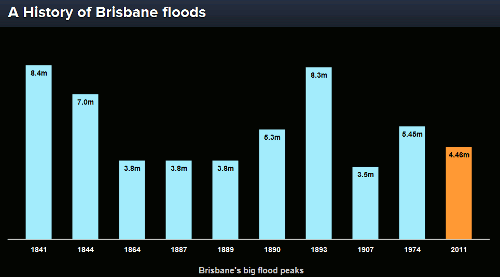
A bit of Brisbane’s flood history:

1824 John Oxley, early explorer, mentioned evidence of an inundation which he discovered on 19 September 1824 in an area north of the junction of the Bremer with the Brisbane: “the starboard bank an elevated flat of rich land, declining to a point where had evidently by its sandy shore and pebbly surface, been at some time washed by an inundation; a flood would be too weak an expression to use for a collection of water rising to the full height (full fifty feet) which the appearance of the shore here renders
possible.” (Ref 2)
1825 Major Edmund Lockyer mentioned the evidence of a large flood while in the area of today’s Mount Crosby pumping station – “marks of drift grass and pieces of wood washed up on the sides of the banks and up into the branches of the trees, marked the flood to rise here of one hundred feet”. Lockyer’s descendant, Nicholas Lockyer, in 1919 made the following remarks: “the official record of the flood level of the river on the 4th February 1893 at the Pumping Station, the site of which is within a mile of Lockyer’s camp, was 94 feet 10.5 inches. His remarks would seem to suggest that between Oxley’s visit in September 1824 and his [Major
Edmund Lockyer] own in September 1825, the river had experienced a flood as great as that subsequently experienced in February 1893.” (Ref 2)

Source and references: http://www.bom.gov.au/hydro/flood/qld/fld_history/brisbane_history.shtml

More history:

brisbane-flood-peaks.gif

Source: http://www.abc.net.au/news/infographics/qld-floods/peaks.htm

« Previous PageNext Page »

© 2007-2026 The Carbon Sense Coalition. Material on this site is protected by copyright. However we encourage people to copy, print, resend or make links to any article providing the source, including web address, is acknowledged. We would appreciate notification of use.
The Carbon Sense Coalition is proudly powered by WordPress and themed by Mukka-mu