Concerned Household Electricity Consumers Council Press Release


PRESS RELEASE

The Concerned Household Electricity Consumers Council in its Comment Calls on President Trump and EPA to Repeal and Not Replace the Clean Power Plan(CPP).
CHECC CPP ANPRM Replacement Comment Overview FINAL 022718 PDF

 Key Comment Conclusions*: 

  • CO2 is a Beneficial Gas, not a Pollutant. As a result, the Social Cost of Carbon is Negative since CO2 is so very critical to plant growth and therefore human life.

  • The 2009 Endangerment Finding must be reconsidered and rescinded/vacated. Thus, the CPP would not be replaced.

  • All future Federal, State and private sector decisions regarding the Nation’s electric power grid must focus solely on minimizing consumer electricity prices as well as maximizing Grid Reliability and Resilience. No consumer electricity price increases should be permitted by regulators that result from increased Renewables/Energy Storage Grid penetration.

  • The Current Reconsideration of future vehicle MPG Standards must treat CO2 reduction as a cost, not a benefit, so that only consumer preferences matter, not climate change issues. Currently, with low gasoline price expectations, most consumers prefer trucks & SUVs.

*Based on the Concerned Household Electricity Consumers Council (CHECC) Comment in response to EPA’s ANPRM CPP Replacement

CHECC CPP ANPRM Replacement Comment FINAL to EPA 022618 (1)

Filed February 26, 2018

(more…)


Fix the Budget by Cutting Climate Waste


Media Statement by Viv Forbes

Chairman, The Carbon Sense Coalition.

Any quotes taken directly from this statement may be attributed to Mr Forbes

The Carbon Sense Coalition today called on the federal government to reduce the burden of the Climate Industry on all taxpayers and consumers.

The Chairman of Carbon Sense, Mr Viv Forbes, said that the biggest national scandal today was how the whole government apparatus, including the nationalised research and media industries and parts of the opposition, was totally captive to a religious belief that a destructive war on carbon energy will somehow provide benefits to some future generation of Australians by cooling the climate and preventing extreme weather events.

“This is a delusion.”

Quote:

It was the great Milton Friedman who said “There is only one tax on the people and that is government spending”.

Cutting expenditure, not re-arranging expenditure, must be the total focus of this budget.

And the first candidate for spending cuts must be the totally useless Climate Change Industry.

Every department, program, research grant, travel grant or salary with climate, warming, carbon, sustainability, renewable, sequestration, clean coal, ethanol or IPCC in its title or mission statement should be abolished forthwith together with its staffing. This list must include but not be restricted to:

The Australian Renewable Energy Agency (Arena) and its dependants, saving about $3.2 billion.

The Clean Energy Finance Corporation, saving about $10 billion.

The Emerging Renewables Program, saving about $126 million.

The Clean Technology Innovation Program, saving about $200 million.

Subsidies to Coal-fired electricity generators, saving about $5.5 billion. (This has to be the ultimate madness – the government levies a crippling carbon tax on coal-fired electricity generation to force them to close and then pays huge subsidies to the same generators to delay their closure).

All Climate Change “Research” focussed on carbon dioxide, saving about $300 million.

“Contracts for Closure” – payments to ensure closure of some electricity generators (unbelievable – surely the carbon tax will do this).

The Coal Sector Jobs Package – payments to coal mines to offset the cost of the carbon tax- just abolish the tax.

Coal Sector Assistance Package – Subsidies to some Coal Mines (another stupidity – repaying some of the carbon tax they took in the first place).

Everything funded under the Clean Energy Future Plan.

All renewable energy subsidies.

The Low Emissions Technology Demonstration Fund.

The Ethanol Production Grants Program – a subsidy per litre of ethanol produced.

All climate change officials, lawyers, inspectors and auditors everywhere, maybe 13,000 of them saving, say, $2 billion per year.

The offices of the Climate Commissioner and the Clean Energy Regulator – whatever they cost is wasted money.

The whole Carbon Capture and Storage empire – The National Low Emissions Coal Initiative, the CCS Flagships Program, the National Carbon Dioxide Infrastructure Plan, and the Carbon Capture and Storage Institute.

Support for all the International Climate Forums and Conferences via APEC, CEM, G20, IEA, IEF, IPEEC, IRENA, IPCC and all the travel costs associated with attendance.

All handouts under the Green Precincts Fund – $15M spent to date.

All government advertising, market research, media monitoring, media advisers and logo designers promoting the carbon tax, the Department of Climate Change, smart meters or other climate and green energy initiatives.

Donations to Green Friends such as the Climate Institute, the Australian Conservation Council, Climate Works Australia, Green Cross Australia, and the ACTU – $3 million spent already.

To “balance” all of these reduced expenditures the government must also abolish the carbon tax and all fuel taxes not related directly to public road usage and applied to road construction and maintenance.

Note: The above list probably includes errors, double counting and omissions, but such is the confusion and proliferation of the alphabet soup of what poses as “Climate Policy” that it is doubtful if anyone could prepare an accurate and comprehensive list. The only feasible solution is to start cutting, biggest first. None of them will be missed, except with relief by taxpayers and consumers.

Viv Forbes,
Chairman, The Carbon Sense Coalition
www.carbon-sense.com
Rosewood Qld Australia
forbes@carbon-sense.com


Weather Ripples and Climate Tides


Weather Ripples and Climate Tides.

Every time a north wind blows hot air over Adelaide, some Chicken Little cries “Global Warming”. And when an El Nino predictably causes a hot year like 1998 or 2015/16, some sensation-seeking celebrity will trumpet “hottest year eevah”.

They are watching short-term weather ripples and waves and ignoring the underlying climate tide. Daily, monthly and yearly temperature records will always be equalled or broken. That is what weather does – it fluctuates.

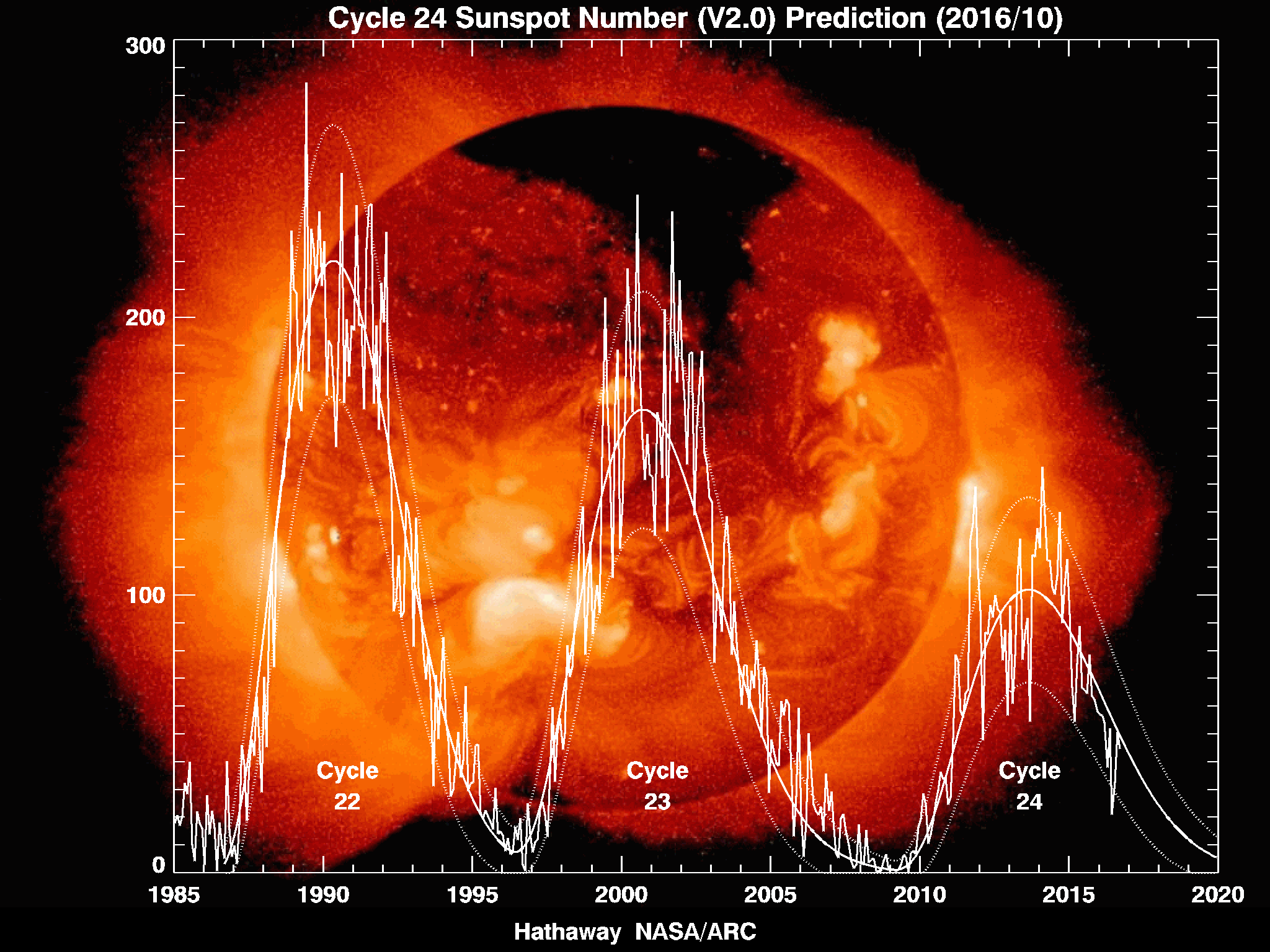
In the medium term, Earth temperature trends are influenced by variations in solar activities as evidenced by sun-spot cycles. These variations affect solar intensity, cosmic rays, clouds and Earth temperature, causing medium-term climatic events like the Little Ice Age and the Modern Warming. There are persuasive signs that recent solar activity has peaked. So maybe we can expect cooler weather soon.

See: http://solarscience.msfc.nasa.gov/images/Cycle22Cycle23Cycle24big.gif

But to see what the climate is doing we must look longer-term and study the glacial cycles. The Milankovitch cycles of Earth in the solar system control these.

See: http://www.indiana.edu/~geol105/images/gaia_chapter_4/milankovitch.htm

Is it warming or cooling now?

See this very informative video by the late Professor Bob Carter:

There are many signs that Earth’s climate is gradually cooling (as Prof Carter shows in the video above).

For example, snow and ice is accumulating.

In the Antarctic, Mawson’s Hut and the Colbeck Hut are being progressively buried in ice.

In Greenland, “The Lost Squadron”, which was forced to land on the Greenland Ice sheet in 1942, was rediscovered 50 years later buried under 268 feet of ice.

Read more, as well as:

  • Poverty and the Environment
  • Making Things Matters

Read the full report: http://carbon-sense.com/wp-content/uploads/2016/04/ripples-and-tides.pdf [PDF, 290 KB]

Tags: Climate cycles, sun spots, ice ages, Milankovitch, Greenland, Antarctic, ice sheets, poverty, green destruction, manufacturing, rationing.


Germany’s Grand Plan to Abolish Carbon Fuels Fails


Germany’s Energiewende – Lessons for Australia from Germany

In March 2017, the German Federal Ministry of Economics and Energy published a brochure announcing that the Energiewende, its renewable energy revolution, was ‘a success story’.

Nothing could be further from the truth.

The Energiewende (Grand Plan) has the goal of making Germany independent of fossil fuels in the long term. Coal, oil and gas were to be phased out, allowing drastic reductions in carbon dioxide emissions. However, these goals have not even begun to be achieved.

The Energiewende was only driven forward in the electricity sector, which, accounts for only one-fifth of energy consumption. There were hardly any successes in the heating/cooling and transport sectors.

And so carbon dioxide emissions in Germany have been rising since 2009, even though well over a hundred billion euros have been spent on the expansion of solar and wind energy over the same period. The financial obligations undertaken in the process will continue to burden taxpayers for another two decades and will end up costing German consumers a total sum of around 550 billion euros.

Despite this enormous effort, security of supply is increasingly under threat. At the same time, people and the biosphere are suffering; wildlife protection has become subordinated to climate mitigation, even though the possibility of achieving the goals of reducing carbon dioxide emissions is becoming increasingly distant and the measures for the energy transition seem to become more and more questionable from a constitutional point of view.

800 regional associations in Germany commissioned a report on the achievements of the Grand Plan, supported by 24 German experts in all relevant fields.

“In this review we would like to inform a public debate and set out a reasonable course for energy policy in Germany.”

It details stark lessons for Australia. They have produced a very clear readable summary of all aspects of the German electricity disaster.

Read more: http://carbon-sense.com/wp-content/uploads/2018/08/1-6-_kompendium-der-energiewende_englisch_1.pdf [PDF, 2.7 MB]

Source: https://www.vernunftkraft.de/


Our Glaciers are Growing, not Melting – More Falsehoods from Al Gore


By Robert W. Felix

8 Mar 10 – “Almost all of the ice-covered regions of the Earth are melting — and seas are rising,” said Al Gore in an op-ed piece in the New York Times on February 27.

Both parts of Gore’s statement are false.

Never mind that Mr. Gore makes only passing reference to the IPCC’s fraudulent claims that the Himalayan glaciers will all melt by 2035. (“A flawed overestimate,” he explains.)

Never mind that Mr. Gore dismisses the IPCC’s fraudulent claims that the oceans are rising precipitously. (“Partly inaccurate,” he huffs.)

Never mind that Mr. Gore completely ignores the admission by the CRU’s disgraced former director Phil Jones that global temperatures have essentially remained unchanged for the past 15 years.

I’ll let someone else dissect Gore’s lawyering comments, and concentrate on just the one sentence about melting ice, because neither part of that sentence is true.

Contrary to Gore’s assertions, almost all of the ice-covered regions of the Earth are growing, not melting — and the seas are not rising.

Let’s look at the facts.

If you click on the words “are melting” in Gore’s article, you’re taken to a paper by Michael Zemp at the University of Zurich. Mr. Zemp begins his paper by warning that “glaciers around the globe continue to melt at high rates.”

However, if you bother to actually read the paper, you learn that Zemp’s conclusion is based on measurements of “more than 80 glaciers.”

Considering that the Himalayas boast more than 15,000 glaciers, a study of “more than 80 glaciers” hardly seems sufficient to warrant such a catastrophic pronouncement.

Especially when you learn that of those 80 glaciers, several are growing.

Growing. Not melting.

“In Norway, many maritime glaciers were able to gain mass,” Zemp concedes. (“Able to gain mass” means growing.)

In North America, Zemp also concedes, “some positive values were reported from the North Cascade Mountains and the Juneau Ice Field.”  (“Displaying positive values” means growing.)

Remember, we’re still coming out of the last ice age. Ice is supposed to melt as we come out of an ice age. The ice has been melting for 11,000 years. Why should today be any different?
I’m guessing that most Canadians and Northern Europeans are very happy that the ice has been melting.

Unfortunately, that millenniums-long melting trend now appears to be changing. No matter how assiduously Mr. Gore tries to ignore it, almost all of the ice-covered regions of the Earth are now gaining mass. (Or, displaying positive values, if you will.)

For starters, let’s look at those Himalayan glaciers. In a great article, entitled “World misled over Himalayan glacier meltdown,” Jonathan Leake and Chris Hastings show that the IPCC’s fraudulent claims were based on “speculation” and “not supported by any formal research.”

As a matter of fact, many Himalayan glaciers are growing. In a defiant act of political incorrectness, some 230 glaciers in the western Himalayas – including Mount Everest, K2 and Nanga Parbat – are actually growing.

“These are the biggest mid-latitude glaciers in the world,” says John Shroder of the University of Nebraska-Omaha. “And all of them are either holding still, or advancing.”

And get this. Eighty seven of the glaciers have surged forward since the 1960s.

So much for Mr. Gore’s “more than 80 glaciers.”

(I don’t know how many Himalayan glaciers are being monitored, but my guess would be fewer than a thousand, so it’s possible that hundreds more are growing. There aren’t enough glaciologists in the world to monitor them all.)

But we don’t need to look to the Himalayas for growing glaciers. Glaciers are growing in the United States.

Yes, glaciers are growing in the United States.

Look at Washington State. The Nisqually Glacier on Mt. Rainier is growing. The Emmons Glacier on Mt. Rainier is growing. Glaciers on Glacier Peak in northern Washington are growing. And Crater Glacier on Mt. Saint Helens is now larger than it was before the 1980 eruption. (I don’t think all of the glaciers in Washington or Alaska are being monitored either.)

Or look at California. All seven glaciers on California’s Mount Shasta are growing. This includes three-mile-long Whitney glacier, the state’s largest. Three of Mount Shasta’s glaciers have doubled in size since 1950.

Or look at Alaska. Glaciers are growing in Alaska for the first time in 250 years. In May of last year, Alaska’s Hubbard Glacier was advancing at the rate of seven feet (two meters) per day – more than half-a-mile per year. And in Icy Bay, at least three glaciers advanced a third of a mile (one-half kilometer) in one year.

Oh, by the way. The Juneau Icefield, with its “positive values,” covers 1,505 square miles (3,900 sq km) and is the fifth-largest ice field in the Western Hemisphere. Rather interesting to know that Gore’s own source admits that the fifth-largest ice field in the Western Hemisphere is growing, don’t you think?

But this mere handful of growing glaciers is just an anomaly, the erstwhile Mr. Gore would have you believe.

Well, let’s look at a few other countries.

  • Perito Moreno Glacier, the largest glacier in Argentina, is growing.
  • Pio XI Glacier, the largest glacier in Chile, is growing.
  • Glaciers are growing on Mt. Logan, the tallest mountain in Canada.
  • Glaciers are growing on Mt. Blanc, the tallest mountain in France.
  • Glaciers are growing in Norway, says the Norwegian Water Resources and Energy Directorate (NVE).
  • And the last time I checked, all 50 glaciers in New Zealand were growing.

But this is nothing. These glaciers are babies when you look at our planet’s largest ice masses, namely, the Antarctic and Greenland ice sheets.

Contrary to what you may have heard, both of those huge ice sheets are growing.

In 2007, Antarctica set a new record for most ice extent since 1979, says meteorologist Joe D’Aleo. While the Antarctic Peninsula area has warmed in recent years, and ice near it diminished during the summer, the interior of Antarctica has been colder and the ice extent greater.

Antarctic sea ice is also increasing. According to Australian Antarctic Division glaciology program head Ian Allison, sea ice losses in west Antarctica over the past 30 years have been more than offset by increases in the Ross Sea region, just one sector of east Antarctica.

The Antarctic Peninsula, where the ice has been melting, is only about 1/50th the size of east Antarctica, where the ice has been growing. Saying that all of Antarctica is melting is like looking at the climate of Oregon and saying that this applies to the entire United States.

There was not any evidence of significant change in the mass of ice shelves in east Antarctica nor any indication that its ice cap was melting, says Dr. Allison. “The only significant calvings in Antarctica have been in the west.” And he cautioned that calvings of the magnitude seen recently in west Antarctica might not be unusual.

“A paper to be published soon by the British Antarctic Survey in the journal Geophysical Research Letters is expected to confirm that over the past 30 years, the area of sea ice around the continent has expanded.”

What about Greenland?

Greenland’s ice-cap has thickened slightly in recent years despite wide predictions of a thaw triggered by global warming, said a team of scientists in October 2005.

The 3,000-meter (9,842-feet) thick ice-cap is a key concern in debates about climate change because a total melt would raise world sea levels by about 7 meters.

But satellite measurements show that more snow is falling and thickening the ice-cap, especially at high altitudes, according to the report in the journal Science.

The overall ice thickness changes are approximately plus 5 cm (1.9 inches) per year or 54 cm (21.26 inches) over 11 years, according to the experts at Norwegian, Russian and U.S. institutes led by Ola Johannessen at the Mohn Sverdrup center for Global Ocean Studies and Operational Oceanography in Norway.

Not overwhelming growth, certainly, but a far cry from the catastrophic melting that we’ve been lead to believe.

Think about that.

The Antarctic Ice Sheet is almost twice as big as the contiguous United States.

Put the Antarctic and Greenland Ice Sheets together, and they’re one hundred times bigger than all of the rest of the world’s glaciers combined.

More than 90 percent of the world’s glaciers are growing, in other words, and all we hear about are the ones that are shrinking.

But if so many of the world’s glaciers are growing, how can sea levels remain the same?

They can’t. The sea level models are wrong.

During the last ice age, sea levels stood some 370 feet (100 meters) lower than today. That’s where all of the moisture came from to create those two-mile-high sheets of ice that covered so much of the north.

And just as the ice has been melting for 11,000 years, so too were sea levels rising during those same years.

But the rising has stopped.

Forget those IPCC claims. Sea levels are not rising, says Dr. Nils-Axel Mörner, one-time expert reviewer for the IPCC.

Dr. Mörner, who received his PhD in geology in 1969, is one of the greatest – if not the greatest – sea level experts in the world today. He has worked with sea level problems for 40 years in areas scattered all over the globe.

“There is no change,” says Mörner. “Sea level is not changing in any way.”

“There is absolutely no sea-level rise in Tuvalo,” Mörner insists. “There is no change here, and there is zero sea-level rise in Bangladesh. If anything, sea levels have lowered in Bangladesh.”

“We do not need to fear sea-level rise,” says Mörner. “(But) we should have a fear of those people who fooled us.”

So there you have it. More falsehoods from Al Gore, the multimillionaire businessman who some say is set to become the world’s first carbon billionaire.

Our glaciers are growing, not melting — and the seas are not rising.

I agree with Dr. Mörner, but I’d make it a tad stronger. We should have a fear of those people who have conned us.

From: www.iceagenow.com/Our_glaciers_are_growing_not_melting.htm


Robert W. Felix is author of Not by Fire but by Ice, and publisher of www.iceagenow.com.


Climate of Confusion


By Keith Orchison

By coincidence I have come across the new “Climate of the Nation” report from the strongly green-leaning Climate Institute on the same day I have been reading the latest Essential Report polling and just after looking at a pre-dawn snapshot of east coast market capacity on a pretty standard winter’s day.

Taking the latter first, at 6.30am today 97.6 per cent of the New South Wales load was being met by black coal generation as the State’s population was getting up and its substantial factory sector was gearing up. If you take NSW, Victoria and Queensland together – they represent 90 per cent of the east coast market – at this point 88.9 per cent of the three-State load was being met by brown and black coal generation with wind power providing 0.4 per cent and solar (naturally as the sun wasn’t yet up) 0.04 per cent.

(Eight hours later, I see, at 2.30pm, black coal generation is still bearing 89.7 per cent of NSW load and coal is accounting for almost 82 per cent of required capacity in the three largest States of the market – with hydro power providing 7.5 per cent and wind/solar 4.3 per cent.)

The question that comes to my mind when I look at data like this is what would be required to replace even half this coal power (let alone all of it) with mostly wind power and solar PVs? What would the total system cost be in a set-up where supply is assured and how would this translate in to retail bills?
(more…)


An Open Letter to Malcolm Turnbull


The Hon. Malcolm Turnbull, MP
Leader of the Opposition
Parliament House
Canberra ACT 2600

Sir:

Re: Global Warming and Emissions Trading Scheme (ETS)

In your statement regarding the ETS, you say that ‘The Coalition supports, and supported when in Government, an environmentally effective and economically responsible ETS being put in place in Australia as part of a co-ordinated global response to climate change’. You then set out nine points that define the Opposition’s policy on this critical question.

Missing from your list is recognition of a key alternative. Australia’s carbon footprint is about 1.0 percent of the global total. Accordingly, nothing that Australians do can have any effect on global warming. How then is it ‘economically responsible’ for us to incur the high costs of transition to ‘clean energy’ when it will have no effect on the reduction of global warming? Isn’t it, indeed, irresponsible to pursue this course?
(more…)


Glaciers And Ice Sheets: Here Today and Here Tomorrow


By Dr. John Happs

How often do the climate alarmists tell us that few glaciers still exist because of (imaginary) global warming and those that remain are rapidly melting away?  Not surprisingly, the alarmists, particularly those from the media and vested interest groups, always point to the Intergovernmental Panel on Climate Change (IPCC) computer model projections, referring to one in particular–the Representative Concentration Pathway (RCP8.5.)

Even the political/ideological IPCC has sensibly branded RCP8.5 as “Highly Unlikely”

https://saltbushclub.com/2020/08/15/ipcc-rcp8-5-model/

So, what are the glacier numbers?

  1. There are more than 200,000 alpine/valley (land-based) glaciers and many others stemming from the ice sheets of Antarctica and Greenland.
  1. Glaciers have advanced, retreated and halted many times over the last 400,000 years being influenced not only by temperature but also by other factors, such as wind, precipitation, altitude, latitude, aspect, topography and slope angle.

Global temperature is often promoted, usually by naïve climate alarmists, as the only important input into glacier formation, growth and retreat yet, in very dry parts of Antarctica, where low temperatures are seemingly ideal for glacier growth, the small amount of net annual precipitation results in glaciers growing very slowly, or even diminishing in size.

Glaciers can also be influenced by sublimation or the transition of a substance directly from the solid to the gas phase. Glaciers can experience this process resulting in the “evaporation” of ice, exacerbated by wind action. Sublimation can be seen in the way that ice cubes left in the freezer will shrink over time.

More than 18,000 glaciers have been identified across 50 World Heritage sites but this represents less than 10% of the Earth’s glaciated area. The media, climate activists and vested interest groups like to argue that all glaciers are receding because global temperature is increasing. Not surprisingly, many glaciers have been retreating since we emerged from the Little Ice Age (1250-1850), a time when many farms and houses across Scandinavia were destroyed by advancing glaciers between the 14th and 19th centuries.

Continue reading here: https://papundits.wordpress.com/2023/01/24/glaciers-and-ice-sheets-here-today-and-here-tomorrow/


Environmentalist Apologises for Climate Scare


Environmentalist Michael Shellenberger was named Time magazine Heroes of the Environment (2008). He wrote an article for Forbes entitled On Behalf Of Environmentalists, I Apologize For The Climate Scare.

According to Shellenberger, “Forbes has censored my article.” (https://twitter.com/ShellenbergerMD/status/1277611390195216390 30 June 2020)

The article has been reposted here: https://environmentalprogress.org/big-news/2020/6/29/on-behalf-of-environmentalists-i-apologize-for-the-climate-scare

Alternate PDF version: https://saltbushclub.com/wp-content/uploads/2020/07/shellenberger-apology.pdf [303 kB]


Of Cabbages, and Kings, and Tariff Feed-ins


“The time has come,” the Walrus said,
“To talk of many things:
Of shoes–and ships–and sealing-wax–
Of cabbages–and kings–
And why the sea is boiling hot–
And whether pigs have wings.”

The Walrus and The Carpenter, Lewis Carroll, from Through the Looking-Glass and What Alice Found There, 1872

Once upon a time there was a land where cabbages were very popular. People used them for all sorts of things. There were central farms where they were grown, and distributed to supermarkets from where people bought them. The subjects in this land could buy the cabbages for about 17 cents each.

One day the King decided that it was a bad thing for the cabbages to be produced by these large farms. He said it hurt the environment to have them transported all the way to the supermarkets. He also said too much water was used on those farms.
(more…)

« Previous PageNext Page »

© 2007-2026 The Carbon Sense Coalition. Material on this site is protected by copyright. However we encourage people to copy, print, resend or make links to any article providing the source, including web address, is acknowledged. We would appreciate notification of use.
The Carbon Sense Coalition is proudly powered by WordPress and themed by Mukka-mu