|
|
By Dirck T. Hartmann Thursday, July 3, 2008
(Editor’s Note: To many in the know, Dirck T. Hartmann, who worked on the Apollo Space Program and many other significant NASA projects, was a fighter pilot in WWII, flying P38s. So when this gifted scientist/engineer/physicist and 87-year-old hero felt compelled to answer the questions of Man Made Global Warming, not only his son and grandchildren knew he had something to say with factual substance, truth and knowledge. What he has to say is clear and concise and should be read by everyone.)
What is your carbon footprint? That is the wrong question to ask. A more meaningful question is – How much carbon dioxide does it take to grow the wheat required to produce a loaf of bread? Or – How much carbon dioxide does it take to grow the corn for the chicken feed required to produce a dozen eggs?
(more…)
July 20th, 2008 |
Categories: The Evidence |
Click the image to download the PDF which includes an order form. Or visit https://www.connorcourtpublishing.com.au/Green-Murder–Ian-Plimer_p_463.html

October 18th, 2021 |
Categories: The Carbon Sense Coalition |
Solar power only works while the sun shines – it is part-time power.
Wind power only works when suitable winds blows – also part-time power.
Batteries only work when charged – part-time power again.
Hydro fails in droughts – more part-time power.
And using full-time power like gas to fill the inevitable supply gaps from part-time power forces backup gas to operate like part-time power.
Moreover, on sunny windy days, wind and solar generators spew out electricity at little extra cost. These erratic surges of part-time power drive short-term electricity prices so low that even low-cost full-time producers like coal cannot operate profitably at those times. They are throttled back and forced to operate as yet another part-time power plant.
24/7 electricity users such as hospitals, trains, factories, refineries, fuel and water pumps, cash registers, infrastructure and mines cannot operate on part-time electricity.
Moreover, every part-time power producer (using sun, wind, batteries, hydro, gas or coal) consumes money full-time for operations, standby, maintenance and replacement. Each also has to fund its own specialised generators, transmission lines, access roads and workforce. Electricity becomes both unreliable and expensive, and consumers suffer.
Using taxes, subsidies, dictates and mandates to replace a full-time power producer like coal with up to five part-time power producers only makes sense in the part-time minds that inhabit Greentopia.
Canberra cannot improve any of this with more laws and regulations – they must REPEAL all the legislation, regulations, subsidies and taxes that created the mess in the first place. State governments too should repeal their silly energy laws, and stop shutting and destroying power stations. More laws and regulations can only make things worse.
To comment on this article visit:
https://wattsupwiththat.com/2017/10/18/green-power-is-part-time-power/
Viv Forbes
26 Nov 2017
November 29th, 2017 |
Categories: The Carbon Sense Coalition |
“For the Greens, a pristine global environment represents earthy perfection. It underpins their ‘ecological wisdom’ and is at the core of the new ethic. It is to be protected and promoted at all costs. Hence, all old growth forests are to be locked up; logging is to be prohibited; wealth is to be scorned; economic growth is opposed; exclusive ownership of property is questioned; there should be a moratorium of fossil fuels exploration; dam construction should be discouraged; genetic engineering and agricultural monoculture is rejected; world trade should be reduced; and a barter economy encouraged.”
From part 2 of The Greens Agenda by Kevin Andrews, MP.
The Greens Agenda: Part 1 – Western culture and the Greens
The Greens Agenda: Part 2 – Ideology
The Greens Agenda: Part 3 – Economic Policies
The Greens Agenda: Part 4 – Social and other policies
Note: Because of the design of the www.kevinandrews.au.com Web site, your initial visit will prompt you to sign up for his newsletter. You can choose to skip that via the lower link there “Skip signup…” Once you have done that once, the links in this posting should work directly.
November 20th, 2010 |
Categories: Policy Issues, Quotes |
Sea levels have been rising and falling for as far back as we have evidence, and current sea levels are lower than they were during the Roman Warm Period.
Robert Endlich has looked at the evidence still visible today:
An important turning point in British history occurred in 1066, when William the Conqueror defeated King Harold II at the Battle of Hastings. Less well-known is that, when William landed, he occupied an old Roman fort now known as Pevensey Castle, which at the time was located on a small island in a harbor on England’s south coast. A draw bridge connected it to the mainland. Pevensey is infamous because unfortunate prisoners were thrown into this “Sea Gate,” so that their bodies would be washed away by the tide. Pevensey Castle is now a mile from the coast – further proof of a much higher sea level fewer than 1000 years ago.
Before modern Italy, the region was dominated by the famous City States of the Mediterranean, among which is Pisa, with its picturesque Cathedral Square and famous Leaning Tower. Located near the mouth of the Arno River, Pisa was a powerful city, because maritime trade brought goods from sailing ships right into the port. Its reign ended after 1300 AD, the onset of the Little Ice Age, when sea levels fell and ships could no longer sail to her port. Once again, some say “river silting” was the cause.
However, Pisa is now seven miles from the Tyrrhenian Sea, with large meanders upstream from Pisa and little meandering downstream. When a river is “at grade,” the downstream gradient is as low as possible, as with the meandering Mississippi River and delta in Louisiana. Rivers with a strong downstream gradient flow to the sea in a direct route, with few meanders, as with the Rio Grande in New Mexico.
The facts of history are clear. Sea level was 400 feet lower at the end of the Wisconsin Ice Age, 18,000 years ago. Sea levels rose rapidly until 8,000 years ago. As recently as 1066, when the Normans conquered England, sea levels were quite a bit higher than today.
During the Little Ice Age, 1300 to 1850 – when temperatures were the coldest during any time in the past 10,000 years – snow and ice accumulated in Greenland, Antarctica, Europe and glaciers worldwide. As a consequence, sea levels fell so much that important Roman Era and Medieval port cities (like Ephesus, Ostia Antica and Pisa) were left miles from the Mediterranean.
Since the Little Ice Age ended about 160 years ago, tide gages show that sea level has risen at a steady rate – with no correlation to the rise in atmospheric carbon dioxide levels.
Sea level is a dynamic property in our planet’s climate cycles, which are closely linked to changes in solar energy output and other natural factors. It is unlikely to change in response to tax policies that make energy more expensive and economies less robust – no matter what politicians in Washington, Brussels or the United Nations might say.
Much to their chagrin, Mother Nature doesn’t listen to them. She has a mind of her own.
Robert W. Endlich served as a weather officer in the US Air Force for 21 years and a US Army meteorologist for 17 years. He was elected to Chi Epsilon Pi, the national Meteorology Honor Society, while a basic meteorology student at Texas A&M University. He has degrees in geology and meteorology from Rutgers University and the Pennsylvania State University, respectively, and has studied and visited the ancient sites of Rome, Ostia Antica and Pisa.
For the full article see: http://carbon-sense.com/wp-content/uploads/2013/12/endlich-sea-level-claims.pdf [PDF, 76 KB]
Reference: http://www.cfact.org/2013/12/01/history-falsifies-climate-alarmist-sea-level-claims/
December 2nd, 2013 |
Categories: Sea Levels |
“The Benefits of Human CO2 Emissions” by Dr Patrick Moore
All life is carbon based and the primary source of this carbon is the CO2 in the global atmosphere.
As recently as 18,000 years ago, at the height of the most recent major glaciation, CO2 dipped to its lowest level in recorded history at 180 ppm, low enough to stunt plant growth. This is only 30 ppm above a level that would result in the death of plants due to CO2 starvation.
It is calculated that if the decline in CO2 levels were to continue at the same rate as it has over the past 140 million years, life on Earth would begin to die as soon as two million years from now and would slowly perish almost entirely as carbon continued to be lost to the deep ocean sediments.
The combustion of fossil fuels for energy to power human civilization has reversed the downward trend in CO2 and promises to bring it back to levels that are likely to foster a considerable increase in the growth rate and biomass of plants, including food crops and trees.
Human emissions of CO2 have restored a balance to the global carbon cycle, thereby ensuring the long-term continuation of life on Earth.
This extremely positive aspect of human CO2 emissions must be weighed against the unproven hypothesis that human CO2 emissions will cause a catastrophic warming of the climate in coming years.
The one-sided political treatment of CO2 as a pollutant that should be radically reduced must be corrected in light of the indisputable scientific evidence that it is essential to life on Earth.
Read More: https://fcpp.org/sites/default/files/documents/Moore%20-%20Positive%20Impact%20of%20Human%20CO2%20Emissions.pdf
And here is an improved version: https://itunes.apple.com/us/book/id1353857523
Dr. Patrick Moore is a Senior Fellow with the Energy, Ecology and Prosperity program at the Frontier Centre for Public Policy. He has been a leader in the international environmental field for over 40 years. Dr. Moore is a Co-Founder of Greenpeace and served for nine years as President of Greenpeace Canada and seven years as a Director of Greenpeace International. Following his time with Greenpeace, Dr. Moore joined the Forest Alliance of BC where he worked for ten years to develop the Principles of Sustainable Forestry, which have now been adopted by much of the industry. In 2013, he published Confessions of a Greenpeace Dropout – The Making of a Sensible Environmentalist, which documents his 15 years with Greenpeace and outlines his vision for a sustainable future.
March 28th, 2018 |
Categories: Carbon Cycle, Greenpeace |
Late on Tuesday, Nov. 12, high tides from the surrounding lagoon surged onto the more than 100 islands that make up Venice, flooding 85% of the city and damaging artwork and many historic sites. The mayor blamed climate change for the flood. Jim Steele wrote an excellent article about the event and climate change. The Great Flood of 1966 was the worst on record. Since then, Venice has been working on the long-delayed MOSE project which was supposed to prevent flooding. High inflows to the Venice Lagoon from the Adriatic Sea are driven by the strength of the Sirocco and Bora winds that cause local sea level to surge. There has been no trend in the winds. Steele wrote “Dwarfing the 1.4 millimeters per year of estimated sea level rise, from 1930 to 1970 Venice sank at the rate of 2.3 millimeters per year, largely due to ground water extraction. After addressing that problem, the rate of sinking slowed, but Venice continues to sink at a rate of 1 millimeter per year.” The 1996 flood happened during a low tide and the 2019 flood during a high tide.
Read More:
https://wattsupwiththat.com/2019/11/18/venice-and-unenlightened-climate-fear-mongering/
November 23rd, 2019 |
Categories: The Carbon Sense Coalition, Venice |
The newly formed Carbon Sense Coalition today described the Global Warming Policies of both Federal and State government and opposition parties as “Policies for Poverty”.
Chairman of the new group, Mr Viv Forbes, says that at a time when scientific and informed opinion was becoming more sceptical of the apocalyptic prophecies of the Global Warming Industry, politicians and the media were competing to propose the most extreme and expensive options to “solve” a non- problem.
(more…)
July 17th, 2007 |
Categories: Policy Issues |
The carbon policies of the Australian government will destroy regional industry.
Most regional industry relies on adding value to the products of primary industries – smelters, refineries, processing plants, cement plants, sawmills, flour mills, abattoirs and rail and port infrastructure. These facilities require cheap reliable electricity, which will never be supplied by green energy toys.
Recently Xstrata announced plans to cease smelting and refining copper in Queensland. Then Blue Scope Steel decided to reduce production and shed workers. Now Rio has signalled the sale of its aluminium processing empire. Next we can expect that a large coal fired electricity generator will be unable to repay its debts. Cement plants will be squeezed and rail and port costs will increase.
All of these projects are denigrated in their own country because they have one thing in common – they rely heavily on carbon fuels such as coal and gas and thus are all threatened by the toxic carbon tax. None of these activities will cease because of our carbon tax. They will either pay foreign spivs for “carbon credits” or the business will transfer to other countries who will welcome our trashed industries.
Not one of these operations will survive if forced to use costly and unreliable wind or solar power.
The 74 green lemmings in Parliament have given us “certainty” – the certainty of capital flight and job losses.
Are we prepared for the new green future where jobless Australians survive from backyard vegie gardens, poaching kangaroos and wild pigs from carbon credit forests and cooking with biomass on a wood stove? Of course we will enjoy pirate movies downloaded at the speed of light using the NBN (as long as the sun is shining or the wind blows).
More:
- The Carbon Dioxide Tax Game
- Speaking of elections, Ontario Wind Turbines Slice Liberal Politicians
- Carbon Dioxide and the Politics of the Carbon Tax
- Julia Gillard explains carbon dioxide to students
- Reduce Australian CO2 emissions and provide low cost power by… building new coal plants!
See http://carbon-sense.com/wp-content/uploads/2011/10/reaping-green-dividends.pdf [PDF, 213 KB]
October 24th, 2011 |
Categories: Alternate Energy, Carbon tax, Humour, Newsletters |
A statement by Viv Forbes, Chairman of the Carbon Sense Coalition.
27 March 2010
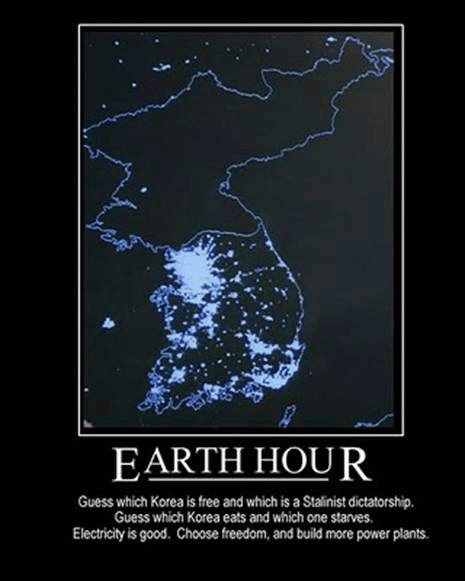
The Carbon Sense Coalition today said that Earth Hour should be renamed “Blackout Night” and be held outdoors, for the whole night, in mid-winter, on the shortest and coldest day of the year – 22 June in the Southern Hemisphere.
The Chairman of “Carbon Sense”, Mr Viv Forbes, said that all supporters of alternative energy should spend just one night in the cold and the dark, emitting no carbon dioxide from coal, oil, gas, petrol or diesel for lights, TV, hot coffee, barbecues or cars. This will be good practice for the blackouts and shortages to come if Penny Wong’s rationing of carbon products and carbon energy is attempted.
“Winter nights are usually still and cold, so the candles crew can experience what it was like depending on alternate energy in the recent snowstorms in the Northern Hemisphere when wind turbines froze and solar panels were covered in snow. The back-to-nature brigade can also try living without iron roofs and concrete walls, both of which require coal and emit carbon dioxide during their production.
“To hold a candles-and-champagne party indoors, on the mildest night of the year, for just one hour, shows that the whole thing is green tokenism. Moreover both candles and champagne emit carbon dioxide. Let the true believers try the real thing in one of the extreme seasons so they can appreciate the great benefits we take for granted when using all of our carbon fuels and foods.
“Instead of sneering at human achievements they should salute the people who keep the lights on for the other 364 days of the year.
“Our salute will be to turn on every light on our property, and we urge all supporters to do the same.
“Australia gets almost 90% of its electricity from hydrocarbon fuels – black coal, brown coal, gas and oil. If the German Greens close their coal and nuclear power they can fall back on gas from Russia, nuclear power from France or hydro from Scandinavia when the lights go out.
“Australia has no prudent neighbours to bludge on if we gamble our future electricity needs on sunbeams, sea breezes and ceiling insulation. If we attempt the massive cuts in carbon dioxide emissions demanded by the deep greens we will see Australia headed for the Romanian power rationing experience – during the Ceaucescu regime in Romania, each house was limited to ONE 25 watt bulb for all of their light.
“All over the world we have aging power stations and an orchestrated campaign by a few warm and well-fed agitators to harass, delay and deter construction of new power facilities.
“Such a campaign can only have one result – many ‘Earth Night’ blackouts are assured.
“So we support ‘Blackout Night’ to prepare our population for the dark days ahead.
“Take a look at a place that celebrates ‘Earth Hour’ every night – Stalinist North Korea. Compare it to free South Korea that keeps its people warm, well fed and working (with the help of Australian coal):
PDF version: http://carbon-sense.com/wp-content/uploads/2010/03/earth-hour-2010.pdf [PDF, 102KB]
March 26th, 2010 |
Categories: Alternate Energy |
« Previous Page — Next Page »
|


 RSS
RSS
