|
|
Windmills and Electricity Supply
Allan Duffy (Press and Journal, August 26), makes a number of assertions and claims which invite challenge.
First, there are far more than a “small number of people” opposing “windfarm sites”.
Second, the cause of this opposition is about more than the potential impact on tourism.
And, finally, they will never generate “excess power” that can be sold to the national grid to enhance Scotland’s economy.
Much of the opposition to windmills relates to their inability to produce electricity when required, combined with their negligible impact on CO emissions because of the expensive associated need for “spinning” back-up from conventional CO-emitting generators.
In his time in Germany, Mr Duffy may have noted that, for all their thousands of windmills, the Germans have not shut down one conventional power station and, in fact, are having to build new coal-fired power stations to meet demand.
If he were to look at the NETA (New Electricity Trading Arrangements) website, he would see that, with all the windmills at present operating in the UK, wind contributes only about 0.1-2% of daily national demand.
Yes, renewable energy must be a component of our future energy mix, but unreliable and expensive windmills are not the answer.
G.M. Lindsay,
Whinfield Gardens,
Kinross, Scotland
Idle Windmills Enrich Some
Yet again, while travelling through the Glens of Foudland, I was struck by a distinct lack of movement by even one of the many wind turbines you drive past.
Another bad day in Scotland’s fight against global warming… sorry, I forgot for a moment that climate change seems to have been adopted as a more appropriate term now.
In the meantime, the landowners, renewable-energy companies – through massive subsidies – and overseas manufacturers of said turbines continue to get rich at the expense of the taxpayer. Strange times indeed.
Chris Davis,
Maryhill, Orton,
Fochabers, Scotland
Source: http://www.pressandjournal.co.uk/Article.aspx/1890438/
August 29th, 2010 |
Categories: Alternate Energy, Wind Power |
This paper provides a factual and objective view of the reality of the effects of some of the world’s greatest oil spills. It particularly deals with the geography of the region in which the spill occurred, the climatic effects on the spill, the probable volume oil spilled, the cleanup actions that followed and the long-term environmental effects.
As an introduction, Part 1 of the paper deals with some of the commonly held beliefs that the world is about to run out of fossil fuels, that oil spills and leaks are universally ‘environmental catastrophes’ and challenges the long term view that the effects are persistent and adverse to the environment. The seemingly endless alarmism that follows each spill is highlighted and the reader is asked to read the remainder of the paper with an open mind, comparing the predictions of doom with the evidence revealed by the reality of hindsight.
It is concluded that the effects of the relatively few spills that have occurred have been exceptionally exaggerated for political purposes by both politicians and environmental activists. Both these alarmist cliques loudly report claims in every case that go far beyond the actual effect of the spill itself. Some of the unfortunate claims by scientists are also exposed as political activism unrelated to scientific method.
Finally the paper provides a ‘prophesy’ (based on the history of previous spills) as to the long-term results and effects of the recent BP Macondo Well blowout in the Gulf of Mexico that commenced on 20th April 2010 and was capped on 29th July 2010, 100 days later.
The author writes under a pseudonym to protect his privacy. However any comments or corrections will be passed onto him. He has experience and contacts in this field and is skilled at extracting and documenting facts.
The report is presented in six parts, with subsequent parts appearing over time:
Part 1: A Summary of Oil Chemistry and the Environmental Effects of Oil.
Available as PDF, 73KB: http://carbon-sense.com/wp-content/uploads/2010/08/oil-spills-1.pdf
Part 2: The World’s Largest Oil Spill – The Gulf War, Kuwait, 1991. The spill, the prophets of doom and the reality that unfolded.
Available as PDF, 596KB: http://carbon-sense.com/wp-content/uploads/2010/08/oil-spills-2.pdf
Part 3: The Exxon Valdez Spill, Alaska. A small spill with huge publicity and extensive cleanup activity, much of which probably made things worse.
Available as PDF, 561KB: http://carbon-sense.com/wp-content/uploads/2010/08/oil-spills-3.pdf
Part 4: The Ixtoc I Well Blowout, Gulf of Mexico, 1979. Despite forecasts of disaster for the environment, within five years the effects of this huge spill were undetectable. In fact the fisheries recovered quickly because they were relieved of fishing pressure, and locals swapped low paying fishing jobs for high paying cleanup or oil industry jobs. As in all spills, the biggest loser was the well owner.
Available as PDF, 88KB: http://carbon-sense.com/wp-content/uploads/2010/08/oil-spills-4.pdf
Part 5: The BP Macondo Well Blowout, Gulf of Mexico, 2010. This may be the second largest man made oil spill in history, and at times the slick covered 6,500 sq km. However about 74% of the oil lost evaporated, dissolved, bio-degraded, or was burned, skimmed or captured. Just 5 days after the leak was plugged, the US government agreed that the oil was no longer a problem. Once more the damage was forecast to be catastrophic, once more it was not. The Gulf of Mexico copes with natural leaks of this size every year. The real costs were political and losses by BP shareholders.
Available as PDF, 133KB: http://carbon-sense.com/wp-content/uploads/2010/08/oil-spills-5.pdf
Part 6: Conclusions & Comments. In 2009, President Obama’s Chief of Staff, Rohm Emanuel said: “Never let a serious crisis go to waste… it’s an opportunity to do things you couldn’t do before.” The recent oil spill in the Gulf of Mexico was a marvellous crisis used by the Obama administration and extreme environmentalists to weaken Big Oil, demonise carbon fuels, and drive the so-called “clean fuel” agenda. Foreign oil producers and the green energy promoters are the beneficiaries. Innocent local businesses and BP were the victims, both of the oil spill but more so of the government actions designed to benefit from the crisis.
Available as PDF, 1200KB: http://carbon-sense.com/wp-content/uploads/2010/08/oil-spills-6.pdf
Note: This 6 part article can be printed from the 6 PDFs and then bound into one indexed report.
UPDATE 9 April 2013:
Those who wish to check the accuracy of the forecasts in these articles should check this reference:
http://www.bbc.co.uk/news/science-environment-22075182
Oil is a natural product and the oceans have been coping with it for millennia.
Author’s Profile
The author retired from the Australian Army as a Lieutenant Colonel in 1986. He served in various postings in Australia, Vietnam, Indonesia, Malaysia and Papua New Guinea. He is a frequent contributor of book reviews, short stories and the occasional article to several journals. He works internationally as a self-employed project manager and project management trainer and consultant.
He has worked part-time for 9 years in the oil and gas industries in the Middle East (Dubai, Qatar, Kuwait and Abu Dhabi) and in North and Central America, and has made it his business to question the experts. Everything he quotes is on the web (except where it is stated as an opinion.)
August 23rd, 2010 |
Categories: Oil spills, Pollution |
Extreme conservation policies are sterilising so much of Australia’s resources that it is becoming a threat to our national security.
Most wars are about land and resources.
In the colonial era, aggressive Europeans swarmed into Africa, the Americas and Australia attracted by underused land, minerals and timber. More recently, Hitler invaded Eastern Europe and Russia in the search for “living space” and access to Black Sea oil and Japan went to war attracted by the resources of South East Asia and Australia.
Australia is the odd man of Asia – a huge land mass with a small population.
Our populous and rapidly developing northern neighbours need the primary products that Australia has in abundance – food, fibres, minerals and energy. So they note with disbelief the way in which Australia is sterilising these valuable resources.
More: http://carbon-sense.com/wp-content/uploads/2010/08/resources-and-security.pdf [PDF, 47KB]
August 17th, 2010 |
Categories: Policy Issues |
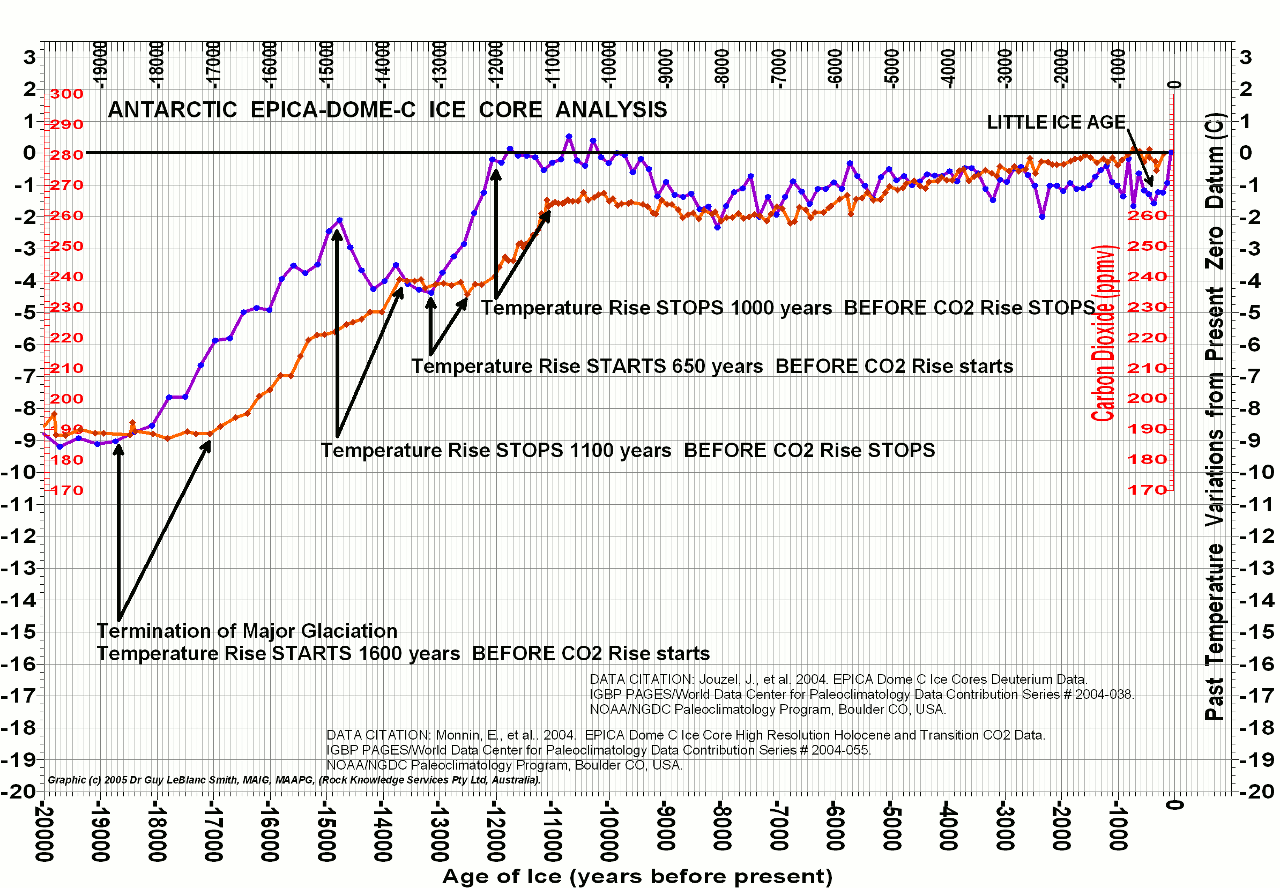
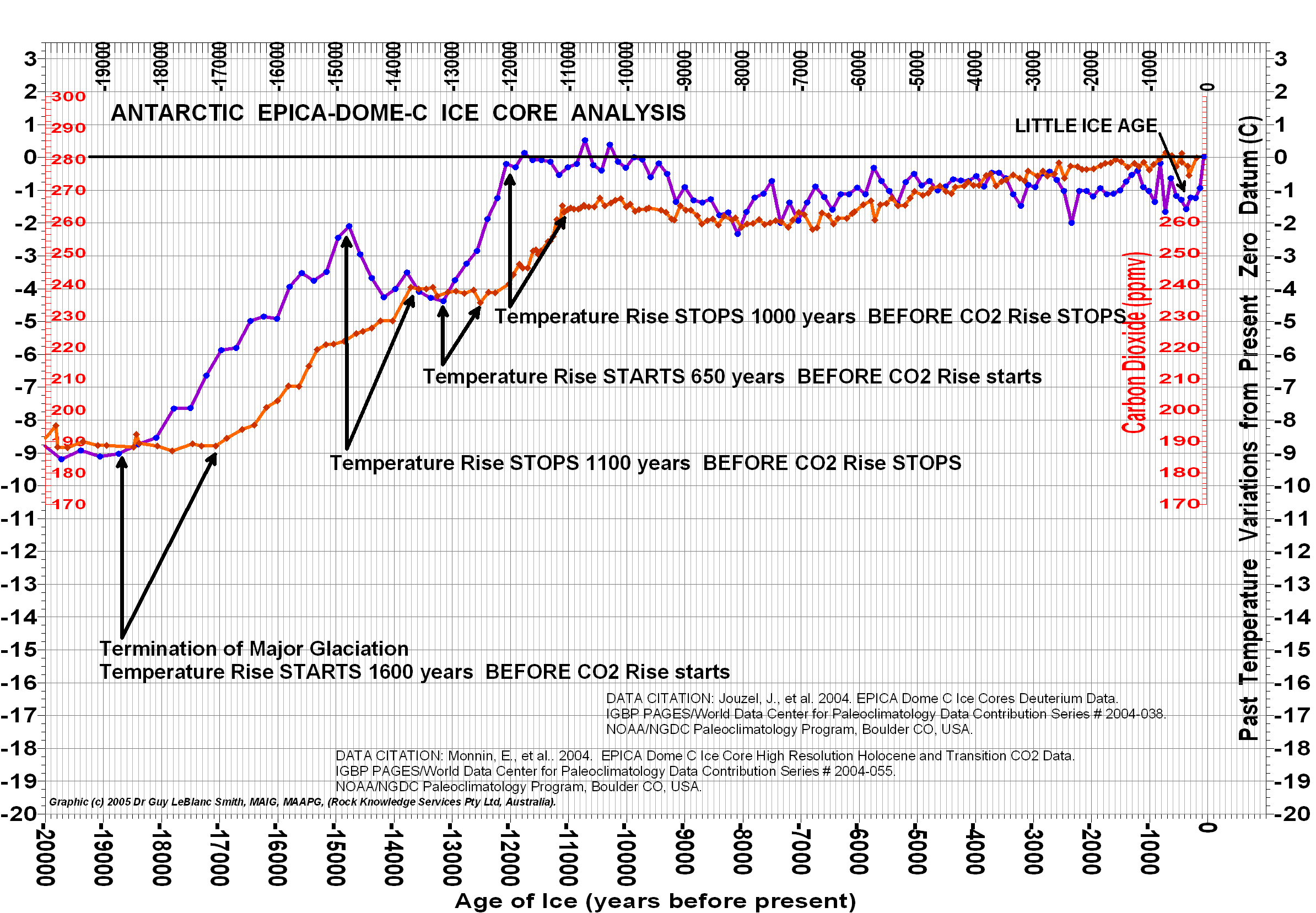
This chart shows the relationship between past temperatures and CO2 concentrations.
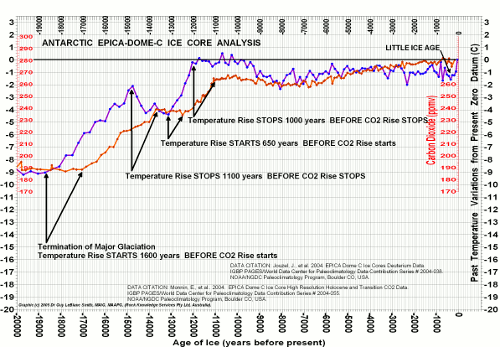
A high resolution (2388×1657) version of the image is available here (246 KB):
http://carbon-sense.com/wp-content/uploads/2010/08/antarctica-temp-co2-l.png
August 12th, 2010 |
Categories: CO2 Greenhouse Science |
The Carbon Sense Coalition today called for an end to wasteful spending on attempts to change the climate by taxing and rationing carbon.
The Chairman of “Carbon Sense”, Mr Viv Forbes, said that man will never control climate.
“Noah did not blame cooking fires for the flood – he built a boat before the rain came”.
Forbes explained:
“It’s time to stop wasting money trying to control the climate – this will be no more successful than slaughtering sacrificial goats, even if tax payers and electricity consumers are to be the goats.
“Man will never control the climate. Wealthy societies can and do improve their local environments of air, land and water. But to think that trading carbon credits, taxing carbon, or subsidising carbon geo-sequestration, wind towers or ethanol production will improve our climate is delusionary…”
More items in this newsletter:
- Greens aim at a black future for all Australians
- Making Things still Matters
- Bio-Bug – the Car for Canberra has been invented
- Bed Bugs for Breakfast?
- Finally, the Voltswagen
Read in full: http://carbon-sense.com/wp-content/uploads/2010/08/be-prepared.pdf [PDF, 46 KB]
August 9th, 2010 |
Categories: Emissions Trading, Newsletters, Policy Issues |
The Carbon Sense Coalition today called for an end to the massive subsidies to the green car industry and to rich buyers of green car toys.
The Chairman of “Carbon Sense”, Mr Viv Forbes, said that to waste taxpayer funds helping foreign car manufacturers to produce cars that consumers don’t want is bad policy.
“Worse still is a policy that encourages people to trash a roadworthy car and buy a trendy new one they do not need.”
Forbes explained:
“To collect, transport and scrap one car and build and deliver another one costs a lot in money, metals, and energy.
“These misguided policies benefit car manufacturers, car dealers, car financiers and some consumers. Everyone else, including the environment, is a loser.
“None of the so called green cars are really green.
“Electric motors, compressed air motors and hydrogen “fuel” are promoted as clean and green, but none of them are sources of energy. All of them need conventional electric power to provide their stored energy.
“Electric cars must fill their batteries from a power point. Compressed air cars must fill their tanks from a compressor which probably uses electricity. And a hydrogen car, if one ever appears, must fill its tank from a refinery using heaps of electricity to produce hydrogen from water or hydrocarbons.
“And where will the electricity come from? In Australia right now 93% of electricity comes from combustion of hydrocarbons such as coal, gas and oil. That will not change dramatically or quickly without putting the lights out. And a dramatic switch to “green” cars plus bans and taxes on hydrocarbon energy increases the chance of that.
“Electric cars are nifty and quiet, and may reduce harmful concentrations of hot exhaust gases in city air, but in Australia they will run mainly on carbon fuel. There will be zero reduction in the production of carbon dioxide (as if that matters anyway).
“The market is the best judge whether diesel, hybrid, electric, petrol or compressed air cars are used. The answer will vary from family to family and from city to country.
“For too long governments have been throwing subsidies at foreign car companies and “green” car buyers. Now they are pushing low cost cars out of the market with their “big bucks for old bombs” giveaway.
“Subsidies always encourage waste of the subsidised product – it is not a sustainable policy. The marginal savings in fuel consumption will never compensate for this extravagance.
“Green car subsidies are dud policies and should be subject to an immediate recall notice.”
Full article: http://carbon-sense.com/wp-content/uploads/2010/08/green-cars.pdf [PDF, 248 KB]
August 4th, 2010 |
Categories: Policy Issues |
Mark Lawson
The Federal Government may have dumped (technically deferred) one nutty green scheme (emissions trading) but an equally nutty scheme remains in place – requiring electricity distributors to buy green electricity.
This scheme is nutty because no one has shown that green electricity supplied to an operating power network actually reduces emissions. The government, various green lobby groups and the mass of voters have simply assumed that it does. There are doubts about efficiency losses due to the whole network having to be retailored to accommodate renewables. And more doubts over just how much additional backup generator capacity will be required for intermittent power sources. These doubts are either ignored or dismissed as “myths”.
…
The Australian government has dived head-first into renewables with both eyes shut, and with the general approval of the voters, who mostly have no idea of what they have approved or how much it will cost. The government should drop the whole renewable energy scheme as too complicated and expensive and unlikely to save much carbon.
The full article: blowing-away-money.pdf [PDF: KB]
Mark Lawson is a senior journalist with The Australian Financial Review. He has written: “A Guide to Climate Change Lunacy – bad forecasting, terrible solutions”.
Connor Court – $29.95. http://www.connorcourt.com/ or book stores.
August 3rd, 2010 |
Categories: Alternate Energy, Policy Issues, Solar Power, Wind Power |
The Carbon Sense Coalition today called for an end to deceptive advertising regarding Global Warming Policies.
The Chairman of “Carbon Sense”, Mr Viv Forbes, said that those calling for a “Price on Carbon” should speak the truth and call it a “Tax on the Production of Carbon Dioxide”.
“Similarly the CPRS (Carbon Pollution Reduction Scheme) had nothing to do with pollution but everything to do with imposing taxes and rationing on economic activity.”
Forbes explained:
“The new green mantra chants: “We need a price on carbon”.
“Carbon is the most useful substance on earth and there is already a price on every product containing carbon – coal and oil, bread and butter, beef and bacon, oil and ethanol, beer and whisky, coffee and tea, cotton and wool, diesel and fire wood, methane and carbon dioxide, petrol and rubber – all are carbon products with an established market price.
“Those who chatter about “a price on carbon” are hiding their real aim which is to reduce human activity by taxing the release of carbon dioxide to the atmosphere. The Office of Fair Trading should be investigating this deceptive election advertising.
“If this tax attempted to cover all releases of carbon dioxide to the atmosphere it would indeed be “A Monster New Tax”.
“Every man and beast, every car and train, every ship and plane, every cement plant and blast furnace, every power station using coal, oil or gas, every wood stove and gas barbeque, every swamp and termite nest – all emit carbon dioxide and thus recycle carbon. Carbon feeds, powers and clothes our world. Any attempt to stop that is suicidal.
“Every producer of carbon products is already taxed – income tax and payroll tax, royalties and resource rent tax, excise and levies, permits and quotas.
“Another carbon tax would just add to the costs of everything, increase poverty, bloat the bureaucracy and send more jobs to China. The only people promoting more taxes on carbon are the anti-growth crowd and the vested interests in the alternate energy promoters.
“We didn’t want the deceitfully labelled Carbon Pollution Reduction Scheme, and we don’t want a new tax labelled “A Price on Carbon”.
Viv Forbes
Chairman, The Carbon Sense Coalition
For a brief report by Ray Evans on the unholy alliance of “Baptists and Bootleggers” supporting more taxes on carbon see: http://www.quadrant.org.au/blogs/doomed-planet/2010/07/the-price-of-carbon
PDF version of this article: http://carbon-sense.com/wp-content/uploads/2010/07/carbon-price-means-tax.pdf [PDF, 62 KB]
July 26th, 2010 |
Categories: Carbon tax, Emissions Trading |
The Carbon Sense Coalition today called for an end to the massive subsidies distorting all energy markets in the name of global warming.
The Chairman of “Carbon Sense”, Mr Viv Forbes, said that if Julia Gillard was honest in her support for a sustainable Australia, she should start dismantling the five unsustainable industries created by climate subsidies.
Forbes explained:
“Today’s buzz word is “sustainable”.
“A sustainable industry cannot rely on government subsidies, market mandates or special deals.
“Warmists and subsidy entrepreneurs have created five unsustainable industries in gullible and guilt stricken western economies – carbon sequestration, ethanol, solar/wind power, carbon forestry and the climate change industry…”
More items in this newsletter:
- Book: Green Hell: How Deep Greens Plan to Control your Life
- Zero Carbon Emissions by 2020 – prices for firewood and candles to boom
- Emissions Trading Scheme reverses Global Warming in New Zealand
- New Danger – Sunset Change
- NASA’s New Goal – better relations with the Muslim world
Read the full newsletter http://carbon-sense.com/wp-content/uploads/2010/07/subsidies-unsustainable.pdf [PDF, 57KB]
July 21st, 2010 |
Categories: Alternate Energy, Emissions Trading, Newsletters, Policy Issues |
While Australia is increasing expenditure of consumer and taxpayer money to the renewables industry, governments around the world have decided that “enough is enough”.
Other countries are realising that renewable energy is a massive waste of tax payer funds and has zero or negligible effect on CO2 emissions. They are thus cutting or eliminating subsidies to the grossly inefficient green power generators.
Here are some recently reported examples:
Spain cuts subsidies to wind and solar:
http://www.reuters.com/article/idUSLDE6611YR20100702
Italy cuts subsidies to wind and solar:
http://www.windfair.net/press/7606.html
Germany cuts subsidies to solar:
http://www.businessgreen.com/business-green/news/2265976/germany-poised-phase-solar
Denmark to cut subsidies to wind:
http://www.ref.org.uk/PressDetails/163
France to slash solar subsidies:
http://seekingalpha.com/article/182530-european-solar-subsidy-slashing-bad-news-for-investors
Ontario cuts incentives for solar:
http://www.cbc.ca/canada/ottawa/story/2010/07/07/ottawa-solar-rate-drop.html
Wind power does not reduce CO2 emissions:
http://www.masterresource.org/2010/06/subsidizing-co2-emissions/
Here are a few examples of the ways in which Australian state and federal Governments subsidise or give unfair advantage to renewables:
- Bans on nuclear power
- Renewable Energy Targets
- Renewable Energy Certificates
- Feed in Tariffs
- Direct government subsidies for renewable energy
- Tax and other incentives
- Cost of the electricity grid enhancements that are needed to accommodate the disruptive, erratic renewable energy generators is shared by everyone instead of being attributed to the renewable energy generators.
- Super Profits Tax on coal mining.
- Threats to shut down or in other ways disadvantage coal fired power plants without fair compensation for the investors.
PDF version: http://carbon-sense.com/wp-content/uploads/2010/07/sunset-for-subsidies.pdf [PDF, 15KB]
July 18th, 2010 |
Categories: Alternate Energy, Policy Issues |
« Previous Page — Next Page »
|


 RSS
RSS