There has been NO significant sea level rise in the harbour for the past 120 years, and what little there has been is about the height of a matchbox over a century.
Along the northern beaches of Sydney, at Collaroy there has been no suggestion of any sea level rise there for the past 140 years. Casual observations from Bondi Beach 1875 to the present also suggest the same benign situation.
A rush to judgement by local councils and State Governments by legislating harsh laws and building covenants along our coastlines now seems misplaced.
The falsehoods and mendacity of the IPCC and climate alarmists should be rejected out of hand, and efforts be made to ensure that science, not propaganda, defines our school curricula in matters of climate and sea levels
Just to keep you abreast of what is going on in France…
You may have heard of the Yellow Vests, who triggered our president Macron into embarking on a “Grand Debate”, mainly on the internet. It is mostly a closed questionnaire with circular arguments on the most surreptitious ways to shoehorn the energy transition, without offering to question its legitimacy in the first place. However, looking closely at the fine print, contributors like associations can still express an open opinion.
On our side Rémy Prud’homme is an emeritus professor of economics, former consultant to the OECD, occasionally to the World Bank, and visiting professor at the MIT. As such he is our chief economist within the steering committee of the French Climato-Réalistes. He came up with the attached “ENERGY TRANSITION IN FRANCE: USELESS, COSTLY, UNFAIR”, initially in French of course. See: https://saltbushclub.com/wp-content/uploads/2019/03/energy-transition-in-france.pdf [PDF, 346 KB]
We thought you may like to know that we Froggies are enduring the same attacks as everywhere in the western world and that we like to voice our concern.
Sympathetically yours,
Pierre Bouteille, on behalf of the French Climato-Réalistes
If you wonder where today’s temperature fits in with the grand scheme of time on Earth since the dinosaurs were wiped out, here’s the history. We start with the whole 65 million years, then zoom in, and zoom in again to the last 12,000 from both ends of the world. What’s obvious is that in terms of homo sapiens history, things are warm now (because we’re not in an ice age). But, in terms of homo sapiens civilization, things are cooler than usual, and appear to be cooling.
There was the First Atlantic Warm Period about 7750 BC
Second Atlantic Warm Period about 7000 BC
First Saharan Warm period about 5800 BC
Second Saharan Warm Period about 5000 BC
Egyptian Warm period about 3200 BC
Sumerian Warm Period about 2200 BC
Minoan Warm Period about 1200 BC
Roman Warm Period about 0 BC
Mediaeval Warm Period about 1000 AD
Modern Warm Period about 2000 AD
All the warm periods prior to the current one have been warmer (in most cases substantially warmer) than the modern warming that we are having hysterics about.
There have been five significant Little Ice Ages scattered between these warm periods.
If you can explain how man-made carbon dioxide was the temperature driver for these events please go ahead and tell me.
Until you do there are, for me, better explanations, principally the magnetic field of the sun.
Roger Dewhurst
Roger is a retired geologist who spent much of his life studying climate history written in sedimentary rocks.
Notwithstanding a data gap from 1791 to 1859, there appears to have been little or no change in the trends of monthly maximum and minimum temperatures for a period of 230 years, from 1788 to 2018, based on comparisons of two data sets—one recorded by First Fleet officer William Dawes, and one from the Bureau of Meteorology (BOM).
Gergis et al 2009, authors of a major study and compilation of the data, conclude that “Remarkably, the records appear comparable with modern day measurements taken from Sydney Observatory Hill, displaying similar daily variability, a distinct seasonal cycle and considerable inter-annual variability.”
This runs counter to the climate alarmism normally published by these authors.
Dr. Howard Hayden is Professor Emeritus of Physics, University of Connecticut. He is the editor of “The Energy Advocate” a pro-energy, pro-science, and pro-technology newsletter.www.energyadvocate.com
We have about a dozen pumped-hydro plants in the US. In some places (that’s why they’re not abundant) it is economically feasible to store energy by pumping water uphill to a higher reservoir, and then release it when demand is high.
Hydro has the advantage of being a system that can turn on or off in a hurry. Typically, a dam has a lot of independent water turbines. So you can turn on (say) 50 MW, 100 MW, and so on.
Greenies look at storage systems as their salvation. (Indeed, solar and wind are nearly worthless without back-up.) What they fail to realize is that back-up is far better used with conventional power.
If a back-up system (of whatever type you care to mention) is used with wind or solar, it has to have enough storage to last for days — possibly even weeks — to keep the grid from going down.
Now look what happens in you increase conventional baseload power (the cheapest, most reliable) beyond the actual baseload demand. During times of low demand, you store the excess energy, and then release it during times of high demand. The upshot is that you need to store only something like 20% of one day’s energy rather than 100% energy for many days. (Even a greenie ought to be able to see that 3 or 4 or 5 or … is greater than 0.2.
As to the Australian Snowy 2.0 project, I have no idea whether it makes any sense or not. But if it does, it makes far more sense for conventional power than wind and solar.
According to Australian Climate Commissioners Tim Flannery, Roger Beale, and Gerry Hueston, in their recent report ‘The Critical Decade: International Action on Climate Change’, the reason why Australians are disproportionately to blame for global climate change is because of so called per capita emissions. According to the Climate Commissioners, (21) “the average Australian produces emissions almost five times that of the average Chinese person and 16 times that of the average person from India.”
“The fact is that Australia has the highest per capita emissions of all developed countries, about 27 tonnes per person. This compares to a world average of about 6 tonnes per person, and an average of about 14 tonnes per person in other developed countries. Developing countries consistently point to Australia’s high per capita emissions to justify why we should take strong action on climate change.” (more…)
Redistributing the wealth of Australia and other Western nations, under the control of the UN, to poorer countries, especially impoverished dictatorships, around the world. According to the 2030 Agenda, ‘poverty’ can only be addressed by undemocratically giving money and power to the UN.
The COP21 Paris climate change agreement, comprising SDG 13, is just one part of the 2030 Agenda. The UN version of climate change though, is about global power and money. As UNFCCC chief Christiana Figueres pointed out, the aim of the UN is tobring abouta “centralized transformation“… “one that is going to make the life of everyone on the planet very different.” Figueres continues: “global society, is moving to the point where we are going to need more and more global governance muscle… Climate change is only the first of the major, major planetary challenges that we are being given, almost as a playground… to go into that playground and exercise our global governance capacity”
Controlling lifestyles, energy use, and consumption by defining which activities are accepted by the UN as being ‘sustainable’. Only the UN can control ‘sustainability’.
Controlling education around the globe to ensure all children become activists promoting the UN sustainability agenda.
The UN 2030 agenda is completely open ended, stating no total costs, and stating no limits as far as loss of sovereignty and enforcement mechanisms are concerned.
The American Society of Interior Designers (ASID) advances the interior design profession and communicates the impact of design on the human experience. Laurel & Wolf interior designers in Banglore specialize in every design style, space type and specification. See designer portfolios and styles here!
Every time a north wind blows hot air over Adelaide, some Chicken Little cries “Global Warming”. And when an El Nino predictably causes a hot year like 1998 or 2015/16, some sensation-seeking celebrity will trumpet “hottest year eevah”.
They are watching short-term weather ripples and waves and ignoring the underlying climate tide. Daily, monthly and yearly temperature records will always be equalled or broken. That is what weather does – it fluctuates.
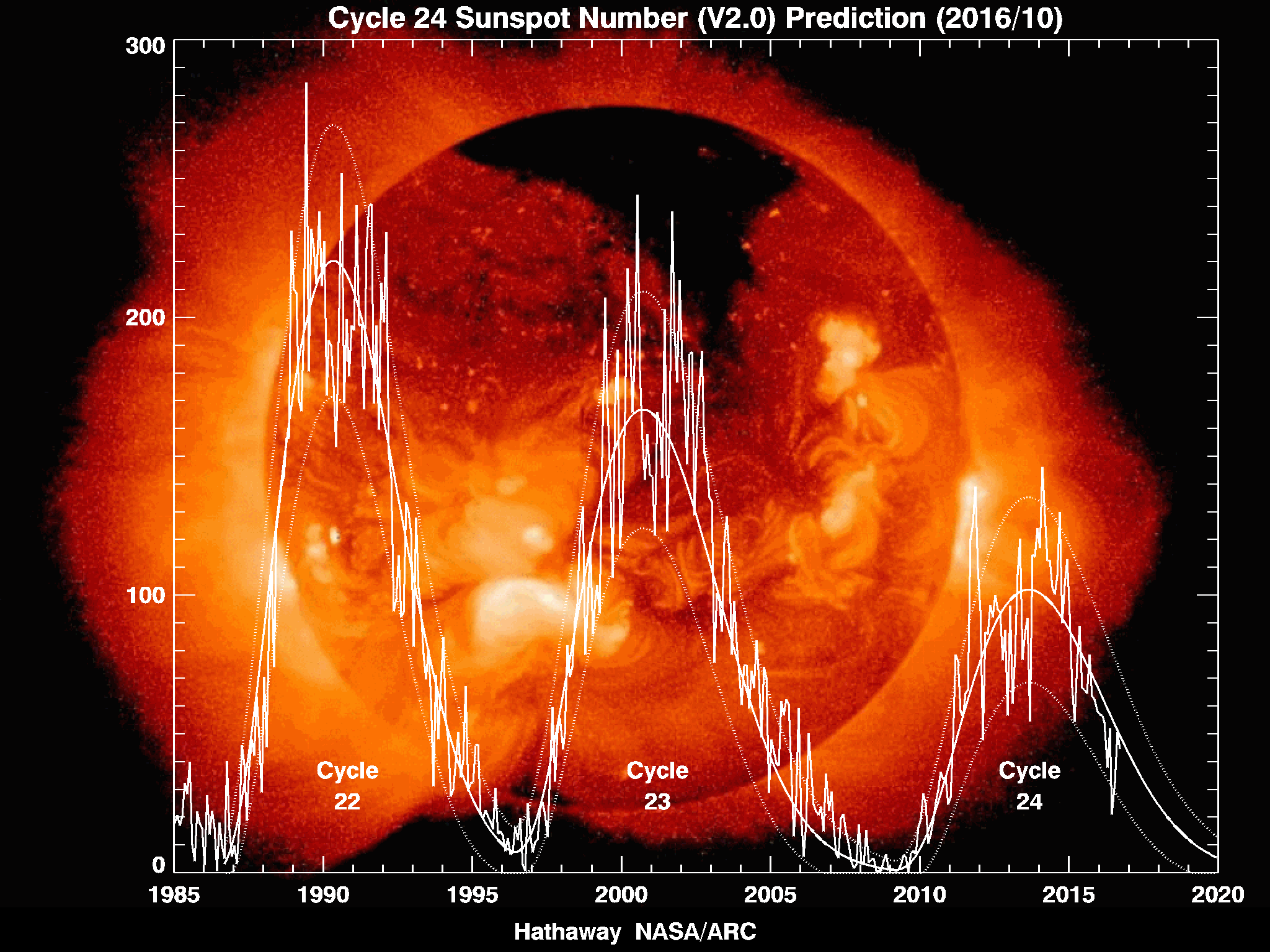
In the medium term, Earth temperature trends are influenced by variations in solar activities as evidenced by sun-spot cycles. These variations affect solar intensity, cosmic rays, clouds and Earth temperature, causing medium-term climatic events like the Little Ice Age and the Modern Warming. There are persuasive signs that recent solar activity has peaked. So maybe we can expect cooler weather soon.
But to see what the climate is doing we must look longer-term and study the glacial cycles. The Milankovitch cycles of Earth in the solar system control these.
See this very informative video by the late Professor Bob Carter:
There are many signs that Earth’s climate is gradually cooling (as Prof Carter shows in the video above).
For example, snow and ice is accumulating.
In the Antarctic, Mawson’s Hut and the Colbeck Hut are being progressively buried in ice.
In Greenland, “The Lost Squadron”, which was forced to land on the Greenland Ice sheet in 1942, was rediscovered 50 years later buried under 268 feet of ice.


 RSS
RSS