|
|
What Happens during a Blackout – an assessment of the consequences of a prolonged and wide-ranging Power Outage in Germany
Infrastructures such as a reliable energy supply, functioning water-supply and wastewater-disposal systems, efficient modes of transport and transport routes and also information technology and telecommunications technology that can be accessed at all times represent the lifeblood of high-technology industrialised nations. The Committee on Education, Research and Technology Assessment therefore commissioned the Office of Technology Assessment at the German Bundestag (TAB) to investigate the possible effects of a prolonged and widespread power blackout on highly critical infrastructures such as drinking water, wastewater, information and communications systems, financial services and health services, especially against a backdrop where the blackout has a cascading effect spanning state and national boundaries.
In Germany, several recent natural disasters and technical malfunctions (Elbe and Oder floods in 2002/2005, power blackout in the Münsterland in 2005, the Kyrill storm in 2007) have highlighted the population’s dependence on such (critical) infrastructures. Supply bottlenecks, public safety problems and disruptions to road and rail transport have revealed the vulnerability of modern societies and made extreme demands on health, emergency and rescue services.
Since almost all critical infrastructures rely heavily on a power supply, a scenario of a widespread and prolonged power blackout involving massive disruption to supplies, economic damage and risks to public safety is a very serious matter. In 2004 the National Crisis Management Exercise (LÜKEX) highlighted the problematic consequences and chains of consequences and also the enormous difficulties faced by federal structures in managing such a crisis and threat situation that strikes without any advance warning.
As far as can be seen, however, the possible consequences of such an event have not yet been subject to an in-depth, systematic analysis in the literature or in official documents.
The analyses conducted by the TAB reveal that the consequences of such a power blackout could at least be akin to a national disaster. All internal and external civil protection forces would need to be mobilised in order to at least mitigate the effects.
The TAB report indicates how the resilience of critical infrastructures could be strengthened and how possible courses of action within the national system for disaster management could be improved. The report thus makes a valuable contribution towards heightening awareness of this issue within industry and society and offers the committees of the German Bundestag a sound basis for further consideration.
The Committee on Education, Research and Technology Assessment The German Bundestag retains the copyright to this publication. Reproduction is authorised, except for commercial purposes, but full acknowledgement is requested.
Source: http://www.tab-beim-bundestag.de/en/publications/books/petermann-etal-2011-141.html
Report: http://www.tab-beim-bundestag.de/en/pdf/publications/books/petermann-etal-2011-141.pdf [PDF, 7.4MB]
March 30th, 2013 |
Categories: Blackout, Policy Issues, Power generation |
From http://www.climateconversation.wordshine.co.nz/
By Richard Treadgold
Len Mills sends us a study of wind farms reported in the Daily Mail. It emerges that their real production history falls a long way short of the breathless claims some make for them.
I too wish to save the world, but not by using wind turbines, because they’ll ruin us first. They’re expensive, ugly, short-lived, noisy to the point of ill-health, ugly, kill bats and birds, they stop generating if there’s too little or too much wind, they demand lots of rare metals and they’re ugly.
Incidentally, if you actually want to contaminate a dependable schedule with a wind turbine’s unpredictable variability, a wind farm needs instant, reliable backup (meaning fossil-fuelled spinning reserve), meaning you greatly increase your establishment costs, about double your operating costs and your CO2 emissions are not reduced by a jot or tittle. I ought to mention they brutalise the landscape.
More: http://www.climateconversation.wordshine.co.nz/2014/11/wind-alone-cannot-keep-the-lights-on/
November 10th, 2014 |
Categories: Alternate Energy, Wind Power |
The recent Earth Hour advertisements exhorted us to turn off the lights in the evening and enjoy a “candle-lit dinner” instead.
This crystallised in my mind the idiocy of this event – everyone knows candles produce more CO2 per lumen than the incandescent bulb, and lots more than a fluorescent bulb.
This is symbolic of the retreat from reason that is Earth Hour – not one single coal-powered station in the country will shut down for earth hour, so no power will be saved, it will instead be wasted.
The fact that “2,848 cities, towns and municipalities in 84 countries have already committed to Vote Earth for Earth Hour 2009” is evidence of nothing but a form of mass hysteria.
The fact that China, India and emerging countries lead the call for action on climate change is a cynical act of hypocrisy, given that they are calling for action by everyone else but China, India and emerging countries.
These countries are themselves the fastest growing “polluters” in the world – China now exceeds the carbon footprint of the USA, and India is not far behind.
The Vote Earth movement seems to me to be a rejection of the Age of Enlightenment in favour of a return to the dim glow of medieval ignorance, where modern-day peasants will sit smugly in the dark as a form of Mother Nature worship.
As Earth Hour asks us to symbolically turn off the light of reason, I have decided to Vote Human instead and turn every light in the house on tomorrow night – I encourage you all to do the same.
In the immortal words of Dylan Thomas: “Rage, rage against the dying of the light!”
ALLEN HORRELL
Oatlands
8th April 2009
See also:
http://www.rossmckitrick.com/uploads/4/8/0/8/4808045/earthhour.pdf
http://www.briansussman.com/environment/more-green-stupidity-earth-hour/
http://blogs.telegraph.co.uk/technology/miloyiannopoulos/9307847/Earth_Hour_is_stupid_and_pointless_Leave_the_blasted_lights_on/
March 26th, 2015 |
Categories: Earth Hour |
Earth has only three significant sources of energy.
First is geothermal energy from Earth’s molten core and decaying radioactive minerals in Earth’s crust. This energy moves continents, powers volcanoes and its heat migrates towards the crust, warming the lithosphere and the deep oceans. It can be harvested successfully in favourable locations, and radioactive minerals can be extracted to provide large amounts of reliable heat for power generation.
Second is energy stored in combustible hydrocarbon minerals such as coal, oil, gas, tar sands and oil shale. These all store solar and geothermal energy collected eons ago and they are the primary energy sources supporting the modern world and its large and growing populations.
Third are radiation and gravitational energies from the Sun and Moon which are captured by the biosphere as heat, winds, tides, rain, rivers and in biomass such as forests, crops and animals. These are the natural “Green” energies that support all processes of life and still support a peasant existence for some peoples.
Green zealots believe that we can and should run modern societies exclusively on “Green” energies, and they have embarked on a war on hydrocarbons. They need to be told that their green energy favourites are just stealing from the biosphere – they are not as green as they claim.
(more…)
July 17th, 2015 |
Categories: Biofuel, Ethanol, Solar Power, Wind Power |
On 22 September, the winter maximum ice sheet extent across the Antarctic reached its greatest area since satellite measurement of the ice extent began in 1979 [1].
This is consistent with satellite lower tropospheric temperature data for the South Polar region at Dr Roy Spencer’s Web site [2] which reveals a slight but not statistically significant rate of cooling for the region for the 36 years of satellite measurement.
Coinciding with this, measurements of the atmospheric CO2 have been collected by NOAA at the South Pole and the data is available on the World Meteorological Organisation Web site [3]. It shows that the CO2 concentration has increased by 17.7% in the same period.
Confirmation of this disparity is available on the WMO Web site where measurements by CSIRO are provided for the CO2 concentration at the Antarctic stations of Casey [4] and Mawson [5]. Comparison of the CO2 concentration with the station’s average temperature data, available at the Bureau of Meteorology Web site [6], showed that both stations have experienced slight, -0.78 deg C per century at Casey and -1.43 deg C per century at Mawson, but not statistically significant cooling over the terms of the measurement. However the CO2 concentration has increased at Casey by 9% in 16.5 years and at Mawson 11.4% in 23 years.
These results are clear evidence that the IPCC proposition that increasing atmospheric CO2 concentration causes warming of the Earth’s surface is invalid. As the rate of increase of atmospheric CO2 has been much the same across the whole of the globe, the above puts paid to the CO2 – global warming fraud.
Sources:
[1] http://nsidc.org/arcticseaicenews/2014/10/2014-melt-season-in-review/
[2] http://www.nsstc.uah.edu/data/msu/t2lt/uahncdc_lt_5.6.txt
[3] http://ds.data.jma.go.jp/gmd/wdcgg/pub/data/current/co2/monthly/spo789s00.noaa.as.fl.co2.nl.mo.dat
[4] http://ds.data.jma.go.jp/gmd/wdcgg/pub/data/current/co2/monthly/cya766s00.csiro.as.fl.co2.nl.mo.dat
[5] http://ds.data.jma.go.jp/gmd/wdcgg/pub/data/current/co2/monthly/maa767s00.csiro.as.fl.co2.nl.mo.dat
[6] http://www.bom.gov.au/climate/data/?ref=ftr [Direct links: Casey; Mawson; use the “All years of data” link at the top right to download a ZIP file.]
Bevan Dockery, B.Sc.(Hons), Grad. Dip. Computing, retired geophysicist.
Formerly:
Fellow of the Australian Institute of Geoscientists,
Member of the Australian Society of Exploration Geophysicists,
Member of the Society of Exploration Geophysicists,
Member of the European Association of Exploration Geophysicists,
Member of the Australian Institute of Mining and Metallurgy.
November 15th, 2014 |
Categories: CO2 Greenhouse Science |
By Graham Williamson
According to Australian Climate Commissioners Tim Flannery, Roger Beale, and Gerry Hueston, in their recent report ‘The Critical Decade: International Action on Climate Change’, the reason why Australians are disproportionately to blame for global climate change is because of so called per capita emissions. According to the Climate Commissioners, (21) “the average Australian produces emissions almost five times that of the average Chinese person and 16 times that of the average person from India.”
This was confirmed by Climate Change Minister Greg Combet:
“The fact is that Australia has the highest per capita emissions of all developed countries, about 27 tonnes per person. This compares to a world average of about 6 tonnes per person, and an average of about 14 tonnes per person in other developed countries. Developing countries consistently point to Australia’s high per capita emissions to justify why we should take strong action on climate change.”
(more…)
September 19th, 2018 |
Categories: The Carbon Sense Coalition |
What a great headline in a weekend newspaper, The rush is on for sky money. The comparison between ETS and the cargo cultists of PNG couldn’t be more apt. Mani bilong skai is already attracting the shysters and get-rich-quick merchants, for the lie is big and the suckers are many (‘Would you like to trade this splendid piece of thin air for some of those old dollars?’). Those old dollars won’t be worth much if ETS becomes law.
Regards
John McRobert
September 6th, 2009 |
Categories: Emissions Trading, Letters |
This chart shows the relationship between past temperatures and CO2 concentrations.
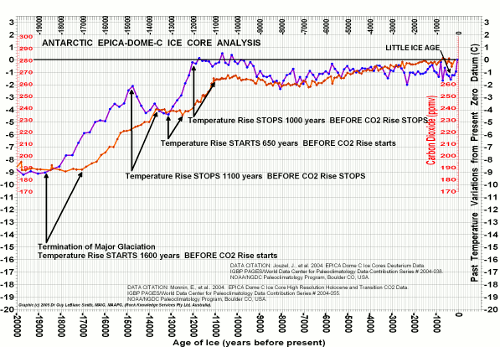
A high resolution (2388×1657) version of the image is available here (246 KB):
http://carbon-sense.com/wp-content/uploads/2010/08/antarctica-temp-co2-l.png
August 12th, 2010 |
Categories: CO2 Greenhouse Science |
“The farming sector will still pay more for inputs such as fertilizer,electricity,fuel and transport and because they have always been price takers you can guarantee ETS charges levied on food processors will end up being paid by the farmer.
“Exempting agriculture is like being thrown from a 10th floor window instead of a 20th floor window – the result is the same.”
Senator John Williams, Senator for NSW, Nov 2009.
November 30th, 2009 |
Categories: Emissions Trading, Quotes |
Ian McClintock
The impacts on agriculture of the CPRS1 in its present form, will be many facetted with major, minor, direct, indirect and subtle effects.
A decision is to be made in 2013 about including agriculture as a ‘covered sector’ in 2015. The Government is ‘disposed’ to include agriculture, which means that it is very likely to be included, and will then become subject to obtaining/buying Carbon Credits, or as they are to be known under the CPRS, Australian Emission Units (AEU’s) to cover the emissions that are calculated as being emitted.
Some AEU’s may be initially given to farmers, or may have to be purchased at auction, or at a fixed price determined by the government.
In any event it is proposed to reduce the number of AEU’s regularly (such as annually) to reduce Australia’s total emissions to meet the target it has set in the CPRS by 2020 and 2050.
The implications of this decision will be costly and dramatic.
More in the full document here. [PDF, 29KB]
July 18th, 2009 |
Categories: Policy Issues |
« Previous Page — Next Page »
|


 RSS
RSS