|
|
The Labor/Green coalition in Australia has declared war on coal, oil and gas and industries that use them. So why is Big Mining not fighting back?
BHP Billiton is a big producer of coal, oil, gas, iron ore, copper, nickel and uranium. Rio Tinto is a big producer of uranium, coal, iron ore, copper and aluminium. Glencore is a big producer of coal, copper, zinc and nickel. And Shell is big in oil, gas and bitumen, manufactures biofuels, and generates peak power with natural gas.
These companies employ competent geologists, physicists and chemists who could tell them that CO2 is not a pollutant, that it is not the primary driver of climate and that climate has been changing since time began. They must know there is no scientific justification for the green war on hydro-carbon fuels – but none of these big miners speak out against this baseless war on their products. UC Browser for Windows Some even waste shareholder funds producing glossy brochures promoting the green agenda – the BHP Billiton document “Climate Change: Portfolio Analysis” reads like it was produced by the Greens.
Big Mining is not that dumb. Their climate “concern” is more motivated by self-interest – they see long-term profits flowing from the silly green agenda. They are also political cowards wanting be loved by guilt-stricken billionaires, business haters from Hollywood and the green mob controlling the ABC/BBC.
Wind and solar power are indeed “free”, but to extract electricity from them is not free – it needs turbines and solar panels, generators and transformers, transmission towers and power lines – all of which boosts demand for metals like steel, copper, zinc, nickel and rare earths.
Moreover, wind and solar are very diffuse power sources and need large areas of land together with webs of access roads and power lines in order to collect significant power. The heavy machinery needed for construction, maintenance and replacements in these green power networks provide ongoing demands for petroleum and mining products. Before one watt of green electricity is generated for consumers, green power has boosted demand for most products of Big Mining.

Permission to use the cartoon is granted providing the source www.carbon-sense.com is mentioned.
To download a tif file of the cartoon (1.6 MM) click:
http://carbon-sense.com/wp-content/uploads/2016/12/flogging-green-horse.tif
Green power also needs back-up power ready to swing into action immediately the wind drops (or blows a gale) or clouds, fog, snow, rain, dust or night-time obscure the sun. This is great news for reliable energy suppliers capable of rapid backup, which usually means gas. Happy New Year 2018 Quotes So Big Gas loves Big Green – it is secretly delighted by the war on coal and the force-feeding of Green energy, as this will cause a boom in gas demand. Lead, nickel, cadmium and lithium miners are also delighted with the soaring demand for energy-storing batteries.
(more…)
December 17th, 2016 |
Categories: Electric Cars, Newsletters, Pollution, Wind Power |
By Graham Williamson
According to Australian Climate Commissioners Tim Flannery, Roger Beale, and Gerry Hueston, in their recent report ‘The Critical Decade: International Action on Climate Change’, the reason why Australians are disproportionately to blame for global climate change is because of so called per capita emissions. According to the Climate Commissioners, (21) “the average Australian produces emissions almost five times that of the average Chinese person and 16 times that of the average person from India.”
This was confirmed by Climate Change Minister Greg Combet:
“The fact is that Australia has the highest per capita emissions of all developed countries, about 27 tonnes per person. This compares to a world average of about 6 tonnes per person, and an average of about 14 tonnes per person in other developed countries. Developing countries consistently point to Australia’s high per capita emissions to justify why we should take strong action on climate change.”
(more…)
September 19th, 2018 |
Categories: The Carbon Sense Coalition |
This chart shows the relationship between past temperatures and CO2 concentrations.
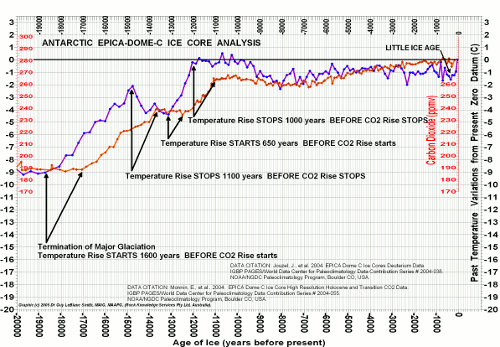
A high resolution (2388×1657) version of the image is available here (246 KB):
http://carbon-sense.com/wp-content/uploads/2010/08/antarctica-temp-co2-l.png
August 12th, 2010 |
Categories: CO2 Greenhouse Science |
What a great headline in a weekend newspaper, The rush is on for sky money. The comparison between ETS and the cargo cultists of PNG couldn’t be more apt. Mani bilong skai is already attracting the shysters and get-rich-quick merchants, for the lie is big and the suckers are many (‘Would you like to trade this splendid piece of thin air for some of those old dollars?’). Those old dollars won’t be worth much if ETS becomes law.
Regards
John McRobert
September 6th, 2009 |
Categories: Emissions Trading, Letters |
Dr David Evans
BSc, BE-EE, MA (Sydney), MS-EE, MS-Stat, PhD EE (Stanford)
[A slightly shorter version of this article appeared in The Australian newspaper on Friday 18 July 2008.]
I devoted six years to carbon accounting, building models for the Australian Greenhouse Office. I am the rocket scientist who wrote the carbon accounting model (FullCAM) that measures Australia’s compliance with the Kyoto Protocol, in the land use change and forestry sector. FullCAM models carbon flows in plants, mulch, debris, soils and agricultural products, using inputs such as climate data, plant physiology, and satellite data. I’ve been following the global warming debate closely for years.
(more…)
July 20th, 2008 |
Categories: The Evidence |

Many on the alarmist side of the climate debate seem to struggle to find rational arguments or evidence to support their cause so they usually resort to character assassination or defamation. A common attack on me is “Viv Forbes is just a coal industry stooge.”
This was put to the test recently at the year’s biggest Mining Industry function – the Queensland Resources Council Annual Forum and Lunch. The delegates on stage at the forum included very senior managers from BHP Billiton, Shell, Anglo-American, Peabody and Glencore. The audience was invited to ask questions.
I asked why people who employed many competent geologists, physicists and chemists never questioned the science behind the global warming scare.
NOT ONE INDUSTRY FIGURE ANSWERED, and the compère quickly moved on.
This is how the Courier Mail reported it:
“YOU might say mining industry figure Viv Forbes was the proverbial fly in the ointment at the Queensland Resources Council “state of the sector” forum in Brisbane on Wednesday.
The climate change denier got a cold response from a panel of industry high flyers when he asked why none of them questioned the science behind global warming “hysteria”.
Indeed, there was an awkward silence before the group, including top guns from Glencore and Shell, quickly moved on.
Forbes, who serves on the board of Brisbane-based Stanmore Coal, chairs a group known as the “Carbon Sense Coalition” and backs “Clexit,” an exit from climate treaties.xposed modules 2017
Just this week he reiterated his call “to defund all CSIRO global warming activities” and slammed “research puppets on the UN man-made global warming agenda”.”
Just for the record, I am no longer a director of Stanmore Coal, and receive zero income from the coal industry. I still hold shares in Stanmore coal, a coking coal producer and exporter.
Viv Forbes
[Click the image for a larger view, and to read more.]
January 21st, 2017 |
Categories: The Carbon Sense Coalition |
“The farming sector will still pay more for inputs such as fertilizer,electricity,fuel and transport and because they have always been price takers you can guarantee ETS charges levied on food processors will end up being paid by the farmer.
“Exempting agriculture is like being thrown from a 10th floor window instead of a 20th floor window – the result is the same.”
Senator John Williams, Senator for NSW, Nov 2009.
November 30th, 2009 |
Categories: Emissions Trading, Quotes |
Ian McClintock
The impacts on agriculture of the CPRS1 in its present form, will be many facetted with major, minor, direct, indirect and subtle effects.
A decision is to be made in 2013 about including agriculture as a ‘covered sector’ in 2015. The Government is ‘disposed’ to include agriculture, which means that it is very likely to be included, and will then become subject to obtaining/buying Carbon Credits, or as they are to be known under the CPRS, Australian Emission Units (AEU’s) to cover the emissions that are calculated as being emitted.
Some AEU’s may be initially given to farmers, or may have to be purchased at auction, or at a fixed price determined by the government.
In any event it is proposed to reduce the number of AEU’s regularly (such as annually) to reduce Australia’s total emissions to meet the target it has set in the CPRS by 2020 and 2050.
The implications of this decision will be costly and dramatic.
More in the full document here. [PDF, 29KB]
July 18th, 2009 |
Categories: Policy Issues |
Philip Wood has a degree in Arts Law, experience in international finance, is an ex-merchant banker and now Managing Director of a minerals processing and industrial waste recycling company.
Companies like this are depend heavily on reliable cheap energy, which has led Philip and his team become directly interested in the science, economics and politics of alleged man-made climate change, a hypothesis that increasingly burdens the energy sector. In so doing, Philip has become deeply doubtful of today’s regular doomsday headlines and futile expensive solutions to the non-existent problem of global warming.
For a series of dramatic graphs that cover all aspects of the climate debate, see, copy and spread around this presentation by Philip: http://carbon-sense.com/wp-content/uploads/2011/06/a-cool-look-at-global-warming.pdf [PDF, 3.7 MB]
June 2nd, 2011 |
Categories: CO2 Greenhouse Science, The Evidence |
Dr. Martin Hertzberg
When my youngest son Russell was eight years old, in 1967, his grade school
teacher asked the students in his class to invite their fathers to visit the class, and to talk
about their work. So Russell invited me. I told him that I could talk about science and
research, but that it was too much to cover in just one period. What area did he want me
to talk about, I asked. He answered: “Oh… uh… just talk about ideas”. There are lots of
ideas in science I replied. “OK” he said, “so talk about the most important idea in
science”. So I agreed. Fortunately, I had a whole week to decide on what the most
important idea of science really was. After much thought, I decided that it was the idea
of energy, and that’s what I talked about… the various kinds of energy and how they
could be transformed form one form to another.
Read the full document [PDF, 48 KB]
September 28th, 2008 |
Categories: Alternate Energy |
« Previous Page — Next Page »
|


 RSS
RSS