Energy Sense and Nonsense


Dr. Martin Hertzberg

When my youngest son Russell was eight years old, in 1967, his grade school
teacher asked the students in his class to invite their fathers to visit the class, and to talk
about their work. So Russell invited me. I told him that I could talk about science and
research, but that it was too much to cover in just one period. What area did he want me
to talk about, I asked. He answered: “Oh… uh… just talk about ideas”. There are lots of
ideas in science I replied. “OK” he said, “so talk about the most important idea in
science”. So I agreed. Fortunately, I had a whole week to decide on what the most
important idea of science really was. After much thought, I decided that it was the idea
of energy, and that’s what I talked about… the various kinds of energy and how they
could be transformed form one form to another.

Read the full document [PDF, 48 KB]


Wind but no Power


We are back from a visit to Melbourne for the Grand Prix. It is not carbon neutral.

After the race we spent 4 days driving along the coast to Adelaide. The weather was excellent with light sea breezes. There are many wind turbines on the nearby hills but alas the wind wasn’t reaching them and most days they were not turning. They look better than they work.

Bob Greenelsh
Brisbane Qld Australia


Greenpeace Always Makes a Disaster out of it


By Daniel Wetzel | As of: 18.12.2017

https://www.welt.de/wirtschaft/article171696371/Eine-Katastrophe-macht-immer-erst-Greenpeace-draus.html

[This English version authorised by Patrick Moore.]


“Arguably, the former environmental activist Patrick Moore is difficult to overcome” – Source: Martin U. K. Lengemann

Patrick Moore once helped to found Greenpeace. Today, the ecologist considers the organization an unscientific lobby group. He has a provocative message: carbon dioxide is not poison. It is good for life on the planet.

The week was not bad for the climate protection movement. France’s head of state Emmanuel Macron had summoned the Climate Chancellor Angela Merkel to the summit in Paris and or emerged with the rank of European “Climate President”. And his plan worked out: UN Secretary-General António Guterres urged that he no longer supports fossil fuels because this would amount to an “investment in destruction”. The World Bank announced that it would stop promoting oil and gas production from 2019 onwards.

With so much international involvement in the fight against CO2, the Greens in Paris missed senior German officials. Merkel was represented by Barbara Hendricks (SPD). From the perspective of green climate politician Annalena Baerbock, the Federal Minister for the Environment only completed an “unmotivated courtesy visit”.

Baerbock’s indignation would certainly have been even greater if she had known which alternative program numerous members of the Bundestag of the Union (CDU) and the FDP had preferred to the Paris climate summit. They had followed the invitation of the Federal Association “Liberaler Mittelstand” to a parliamentary breakfast.

There, Canadian Patrick Moore, one of the founding fathers of Greenpeace, presented his view on climate change, CO2 emissions and energy policy, which – if true – would undermine the foundations of official energy and climate policies. For years, Moore has been one of the archenemies of the world’s largest environmental organization, which he had once brought to the baptism. For today’s activist generation he is the fallen angel of environmental protection.

Carbon dioxide increase did not increase temperature
Nuclear power, genetically modified food, forest conservation, chemicals use, climate change – in almost every major environmental issue Moore represents a view that directly contradicts the Greenpeace policy. In doing so, Moore studied biology, biochemistry and forestry, a doctorate in ecology, and was for years the only trained scientist in the Greenpeace leadership.


German carbon dioxide emissions are rather low by international standards – Source: Infographic The World

Good argument is difficult to master. His quarrels with Greenpeace often end at a high level at a stalemate, statement against statement. Everyone claims that his view of things is the truth. This is how it was when Moore presented diagrams of global temperatures and CO2 concentrations of the last 500 million years to a parliamentary breakfast of about 30 members of the Bundestag.

In another chart, the curves derived from the ice cores of the Russian Antarctic station Vostok, provided no evidence, according to Moore, that the CO2 content in the atmosphere had raised the temperature. On the contrary, he explained to the perplexed MPs: “The CO2 value follows the change in temperature, not the other way around.”

Moore does not deny that the CO2 concentration has risen sharply since the beginning of the Industrial Revolution. Nor does he shake the fact of global warming. Only he claims that one has nothing to do with the other. The curves of shark attacks and ice-cream consumption also showed a strong correlation, he reveals. “Correlation does not prove causation.”

The Sun’s activity affects the world climate
According to Moore, there are many complex factors that change the climate. Solar activity is part of it, cloud formation and much more. When the earth’s temperature rises, the oceans “emit” more CO2. A rise in carbon dioxide would be the consequence, not the cause of global warming. The basic assumption of many climate scientists that carbon dioxide is the main trigger of global warming is a “hypothesis” for Moore, nothing more.

“There is no definitive scientific evidence that carbon dioxide is responsible for the slight warming of the global climate that has occurred in the last 300 years – since the Little Ice Age,” says Moore. “Such a proof would have been documented – that’s not the case.”

The objection that 97 percent of all climate scientists attribute CO2 to the role of the greenhouse gas does not impress Moore. He refers to a booklet from 1931. The title: “100 authors against Einstein”. With great numerical superiority, scientists attacked the theory of relativity that a young patent attorney named Albert Einstein had published a few years earlier.

Einstein responded as relaxed as Moore today: “If I was wrong, it would be sufficient for a single author to refute me.” the IPCC of the United Nations, the ultimate judge in matters of climate change, certainly does not impress Moore.

Climate council focuses on human influence
His skepticism derives from the statutes of the IPCC: The committee has the mission to explicitly investigate only the human impact on climate change. For the study of the natural causes of climate change, therefore, the IPCC lacks any mandate. This leads to a conflict of interest: If the UN body finds no human cause of global warming, it loses its right to exist.

In any case, because of its composition, the IPCC does not enjoy the confidence of the former Greenpeace chief. The IPCC was founded by the World Meteorological Organization (WMO) and the United Nations Environment Program (UNEP). According to Moore, “people who care about the weather forecast for the next week” and environmentalists “who focus on daily politics”. That does not indicate competence for the evaluation of the ages of the Earth.

“Why does no one ask geologists, paleontologists, astrophysicists?” After all, the IPCC always expresses only a “concern” about climate change in its progress reports, Moore states. “Greenpeace always makes a disaster out of it”. Since leaving Greenpeace in 1986, Moore repeatedly accuses the environmental organization of unscientific alarmism.
 

Greenpeace has been attracting attention for decades through spectacular actions. Here activists rappel off the cooling tower of the Neurath coal-fired power plant. The slogan: “CO2 kills” – Source: picture alliance / dpa

When Greenpeace was planning a worldwide campaign against the use of chlorine in the 1980s, Moore’s loyalty ended. Chlorine is the eleventh most common element in the earth’s crust, the most important element for public health in human history, and the raw material for countless medicines.

He does not want to force environmental protection at the expense of people. In the environmental organizations, however, the belief has spread that humans are the enemies of the Earth, which he could not support. Moore withdrew himself after 15 years in the Greenpeace peak body. He first became a salmon farmer and then an independent environmental consultant.

He also accepted positions from the nuclear industry and forestry companies in Asia and North America, but he still does not sacrifice his environmental credentials. Although 70, Moore does not expect his crusade against environmental fear mongering is coming to an end anytime soon.

Without CO2, our earth would have long been a dead planet
It annoys him that CO2, the basic building block of all life on earth, is denounced by climate protectors to school classes as a “poison”. Without the gas, Moore said, “our Earth would be a dead planet.”

In the Bundestag he projected graphs on the wall, showing that the CO2 concentration in the atmosphere has been steadily reduced for 150 million years by natural deposition on the seabed and in the earth’s crust.

In primeval times, the amount of carbon dioxide was ten times higher than today’s levels – at the same time there was an explosion of flora and fauna. “Even today, the plants would like to have more CO2,” says Moore, pointing out that “every professional greenhouse farmer fertilizes his plants with CO2 input.”

Concentration approached dangerously low levels
The real drama is not the warming, but the decay of the CO2 concentration in the atmosphere. From more than 4600 parts per million (ppm) it had dropped to barely 180 ppm during the last glaciation. “This is only 30 ppm above the level at which plants begin to die,” says Moore. This was only 18,000 years ago, a geological blink of an eye. It is largely due to the burning of fossil fuels by humans, that the CO2 content has increased again to about 400 ppm today.

If man were to support natural CO2 reduction and ban fossil fuels, “life on earth would be over in less than two million years,” claims Moore. “The fact is that the CO2 concentration in the atmosphere has been dropping to a dangerously low level for a very long time”.

“Human combustion of fossil carbon sources helps restore a balance to the global carbon cycle,” says Moore. More carbon dioxide would contribute to more plant growth, more trees and larger food harvests.

Climate goals risk Germany’s prosperity
Germany will miss its climate targets for 2020 – and more drastically than expected. The Federal Environment Ministry has calculated this. Above all, the cause is the increasing fuel consumption in road traffic. Source: N24 / Daniel Franz

Germany is missing its climate goals by miles. From an economic point of view, it is impossible to live up to the promises made by the government for CO2 reduction by 2030. This results from a calculation from the Ministry of Economic Affairs. If the analysis of the former Greenpeace leader is correct, it would undermine the basis of an energy policy that derives its legitimacy from mainstream climate science. A layman may wish for open discussion in the face of such a fundamental dispute. But such a serious discussion is not expected in today’s political climate.

The climate “scientists” had already declared their knowledge before the summit in Paris was completed: The climate debate is finished. A dictum that makes Moore quite certain that “in the best scientific tradition, skepticism is almost mandatory.”

© WorldN24 GmbH. All rights reserved.


John Oxley on the Brisbane floods


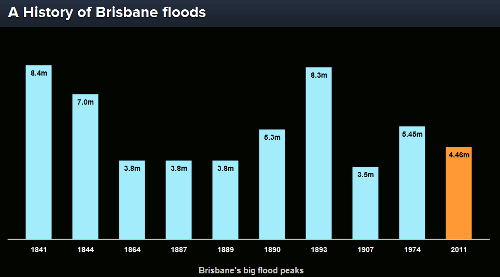
A bit of Brisbane’s flood history:

1824 John Oxley, early explorer, mentioned evidence of an inundation which he discovered on 19 September 1824 in an area north of the junction of the Bremer with the Brisbane: “the starboard bank an elevated flat of rich land, declining to a point where had evidently by its sandy shore and pebbly surface, been at some time washed by an inundation; a flood would be too weak an expression to use for a collection of water rising to the full height (full fifty feet) which the appearance of the shore here renders
possible.” (Ref 2)
1825 Major Edmund Lockyer mentioned the evidence of a large flood while in the area of today’s Mount Crosby pumping station – “marks of drift grass and pieces of wood washed up on the sides of the banks and up into the branches of the trees, marked the flood to rise here of one hundred feet”. Lockyer’s descendant, Nicholas Lockyer, in 1919 made the following remarks: “the official record of the flood level of the river on the 4th February 1893 at the Pumping Station, the site of which is within a mile of Lockyer’s camp, was 94 feet 10.5 inches. His remarks would seem to suggest that between Oxley’s visit in September 1824 and his [Major
Edmund Lockyer] own in September 1825, the river had experienced a flood as great as that subsequently experienced in February 1893.” (Ref 2)

Source and references: http://www.bom.gov.au/hydro/flood/qld/fld_history/brisbane_history.shtml

More history:

brisbane-flood-peaks.gif

Source: http://www.abc.net.au/news/infographics/qld-floods/peaks.htm


Windmills and Electricity Supply


Windmills and Electricity Supply

Allan Duffy (Press and Journal, August 26), makes a number of assertions and claims which invite challenge.

First, there are far more than a “small number of people” opposing “windfarm sites”.

Second, the cause of this opposition is about more than the potential impact on tourism.

And, finally, they will never generate “excess power” that can be sold to the national grid to enhance Scotland’s economy.

Much of the opposition to windmills relates to their inability to produce electricity when required, combined with their negligible impact on CO emissions because of the expensive associated need for “spinning” back-up from conventional CO-emitting generators.

In his time in Germany, Mr Duffy may have noted that, for all their thousands of windmills, the Germans have not shut down one conventional power station and, in fact, are having to build new coal-fired power stations to meet demand.

If he were to look at the NETA (New Electricity Trading Arrangements) website, he would see that, with all the windmills at present operating in the UK, wind contributes only about 0.1-2% of daily national demand.

Yes, renewable energy must be a component of our future energy mix, but unreliable and expensive windmills are not the answer.

G.M. Lindsay,
Whinfield Gardens,
Kinross, Scotland


Idle Windmills Enrich Some

Yet again, while travelling through the Glens of Foudland, I was struck by a distinct lack of movement by even one of the many wind turbines you drive past.

Another bad day in Scotland’s fight against global warming… sorry, I forgot for a moment that climate change seems to have been adopted as a more appropriate term now.

In the meantime, the landowners, renewable-energy companies – through massive subsidies – and overseas manufacturers of said turbines continue to get rich at the expense of the taxpayer. Strange times indeed.

Chris Davis,
Maryhill, Orton,
Fochabers, Scotland

Source: http://www.pressandjournal.co.uk/Article.aspx/1890438/


Tree Growth Near Power Stations


I am a director of an innovative company, Aust Pacific Forest Management (APFM) which has developed and patented the world’s first mechanical pruner for plantation trees. To grow knot free timber which has significantly greater value than knotty planks, the lower storey must be pruned to maintain the knotty core at around 100 mm diameter. To date this has to be done with hand tools, a hazardous and tedious operation in which it takes a day for 1 man to prune 100 trees. Our pruning head can trim 2,000 trees in one 8 hour shift, with surgical precision such that the bark of the tree is undamaged. The testing on the pruning head was done some 5 years ago using 100 trees given to us by Queensland Forestry as thinnings from their pine plantations near the Tarong Power Station in south-east Queensland. Fortunately 50 of these trees were taken from an area within a few kilometres from the power station, and the other from near the township of Blackbutt 15 to 20 km distant from the power station.

An interesting observation in revisiting these forestry sites was finding proof that trees in the vicinity of the coal-fired power station are growing more vigorously than similar trees 15 km away. The plantations in both locations had been established for 10 years, would have experienced a similar climate history, and the soil at the 15 km distant location looked quite rich compared to the soil near the power station. We measured the breast height circumference of a number of typical trees at both locations, and found that on average, over 200% more timber growth had occurred in the trees close to the power station as compared to those furthest from this significant source of carbon dioxide. APFM has a record of the measurements taken and photographs of the trees in both areas, and although this is far from a controlled scientific experiment, the huge difference in timber volume between the two locations is quite remarkable and consistent with other scientific reports where plants are grown in controlled greenhouse conditions.

All of our library research and investigations into greenhouse conditions using carbon dioxide enriched air, together with various reports, lead us to conclude carbon dioxide, a gas which is heavier than air, is best left to flow into the forests to encourage plant growth. All of your excellent research and conclusions from many other reputable groups also leads to the conclusion that man-made carbon dioxide is only beneficial to life on earth, and that efforts to trap and store this gas are a colossal waste of time and money.

We are therefore examining ways to introduce carbon dioxide from coal-fired power stations not only into the forests, but into croplands to enhance food productivity.

John McRobert BE (Civ)
Director APFM
Brisbane Q 4001


New Resource―Quote List for Climate Change, Energy, Environment


By Steve Goreham

I’m announcing a new on-line quote list resource for journalists, writers, and authors on climate change, global warming, energy, and the environment. You can find the list here.

al-gore-article.jpg

The list contains more than 450 quotes and 20,000 words from political leaders, scientists, environmentalists, and news media headlines. It currently includes more than 30 quotes by or about the IPCC, more than 30 quotes by recent political leaders, and more than 60 quotes on energy. The compilation of quotes is a collection from my two books on climate change, but will grow to include additional quotes in the future.

Citations from books, technical articles, news media, and web sites are provided. I’ve stated the original source of the quote wherever possible.

To help user search efforts, the quote list is divided into the following categories:

  • Atmospheric CO2, Greenhouse Effect
  • Carbon Taxes, Business
  • Climate Change, General
  • Climategate
  • Energy, Biofuels
  • Energy, Hydrocarbons
  • Energy, Wind and Solar
  • Energy, Other
  • Environment, Pollution
  • Gore, Al
  • Hansen, James
  • Health Effects
  • Icecaps, Sea Level
  • IPCC
  • Media
  • Models
  • Ocean Acidification
  • Overpopulation
  • Polar Bears and Extinction
  • Political Leaders
  • “Remedies”
  • Science Settled & Deniers
  • Science Organizations & Funding
  • Solar Effects
  • Temperature
  • United Nations
  • Weather, Droughts & Floods
  • Miscellaneous Great Quotes

Please take advantage of the resource. Please also let me know of any needed corrections.

Steve Goreham is Executive Director of the Climate Science Coalition of America and author of the new book The Mad, Mad, Mad World of Climatism: Mankind and Climate Change Mania.


Carbon Capture & Burial also Wastes Energy


Here is another Monument to the Madness of CCB (carbon capture and burial) – it needs a lot of energy – currently estimated to require 30% of the output of a power station.

So in order to satisfy the existing market for electricity, we would have to build a new power station for every three existing ones just to provide the power to capture and bury, not just the CO2 from the existing ones, but also from the new one as well.

Most coal fired power stations are about 33% efficient. Put simply, they burn 3 tonnes of coal to get the equivalent energy of 1 tonne. With CCB, they will now burn 4 tonnes of coal and increase CO2 emissions by 33% for the same useful output.

If however we spend the money required for CCB on increasing the efficiency of thermal power stations even to a modest 50%, they would only need to burn 2 tonnes of coal to get the equivalent energy of 1 tonne and that alone will reduce CO2 emissions by 33%.

Combined cycle is already at 50% and China has been developing super critical boiler temperatures which they claim will be 50% efficient.

But what does Government do? They introduce a tax, as a solution which may not work, for a problem which may not exist.

Clive Gard MIE Aust


The High Price of PC Power


By Ray Evans and Tom Quirk

The story of how a combination of green missionaries and vested interests have distorted and crippled the Australian electricity industry.

Evans and Quirk conclude:

“By 2020 annual electricity consumption in eastern Australia is estimated from NEMMCO data to be 347 Twh. If renewables are to provide 20 per cent, and no new hydro is to be permitted, electricity production from wind farms (or other renewable sources) must provide 53 TWh. Ignoring for the moment the insuperable problem of unpredictability, and assuming a Load Factor of 25 per cent, this will require a total of 27,000 MW of windmill capacity. Every bit of coastline, every mountain ridge, and much else that can be secured for windmills will have to be pressed into service to meet this target.

“The capital cost of wind power is considered to be $2000 per kW, and so an extra 26,000 MW will cost $52 billion. And back-up will be required. So in addition to new coal plant required to provide an additional 60 TWh, back-up generation of at least 23,400 MW will be required. All of this will have to be paid for by the electricity consumer. These numbers could not appear in any Commonwealth budget; no government could justify that sort of expenditure.

“On top of all this we have system stability problems created by widely dispersed power sources, spread over tens of thousands of square kilometres; whose output can vary dramatically as the wind gusts and dies down; that are connected to the main grid by long, weak transmission lines—a system operator’s nightmare. Such a transmission network, weak and unreliable as it will be, will cost at least $30 billion.”

For the full article see:

http://www.quadrant.org.au/magazine/issue/2009/3/the-high-price-of-PC-power


How Green is my Energy


by Geoffrey Luck
June 24, 2011

Take a big deep breath, Bob Brown – savour the 78 parts of nitrogen, 21 of oxygen, and the smidgen of carbon dioxide – and contemplate the folly of your alternative energy ideas. Renewables are not green. That’s the view of one of the pioneers of climate science politics. Jesse Ausubel, Senior Research Associate in The Rockefeller University’s Program for the Human Environment, helped organise the first UN World Climate Conference in Geneva in 1979. He is an avowed ‘deep green’ scientist who believes the essence of being green, and therefore his mantra, is no-new-structures. For years he has been arguing heretical views on energy. In the wake of the Productivity Commission’s scathing comments on renewables, now is the time to listen to him.

Ausubel has a list of heresies that might horrify the true believers in wind and solar power, electric cars and distorting government subsidies:

  • Renewables are not green.
  • The idea of resource exhaustion is irrelevant.
  • Hydrocarbons are not the stored energy of the sun.
  • Little more than 50% of energy will ever be electrified.
  • Nuclear is green, but nuclear plants must make hydrogen as well as electricity.
  • Most surprising of all – decarbonisation has been going on for almost two centuries – without a policy for it.

(more…)

« Previous PageNext Page »

© 2007-2026 The Carbon Sense Coalition. Material on this site is protected by copyright. However we encourage people to copy, print, resend or make links to any article providing the source, including web address, is acknowledged. We would appreciate notification of use.
The Carbon Sense Coalition is proudly powered by WordPress and themed by Mukka-mu