|
|
A bit of Brisbane’s flood history:
| 1824 |
John Oxley, early explorer, mentioned evidence of an inundation which he discovered on 19 September 1824 in an area north of the junction of the Bremer with the Brisbane: “the starboard bank an elevated flat of rich land, declining to a point where had evidently by its sandy shore and pebbly surface, been at some time washed by an inundation; a flood would be too weak an expression to use for a collection of water rising to the full height (full fifty feet) which the appearance of the shore here renders
possible.” (Ref 2) |
| 1825 |
Major Edmund Lockyer mentioned the evidence of a large flood while in the area of today’s Mount Crosby pumping station – “marks of drift grass and pieces of wood washed up on the sides of the banks and up into the branches of the trees, marked the flood to rise here of one hundred feet”. Lockyer’s descendant, Nicholas Lockyer, in 1919 made the following remarks: “the official record of the flood level of the river on the 4th February 1893 at the Pumping Station, the site of which is within a mile of Lockyer’s camp, was 94 feet 10.5 inches. His remarks would seem to suggest that between Oxley’s visit in September 1824 and his [Major
Edmund Lockyer] own in September 1825, the river had experienced a flood as great as that subsequently experienced in February 1893.” (Ref 2) |
|
Source and references: http://www.bom.gov.au/hydro/flood/qld/fld_history/brisbane_history.shtml
More history:
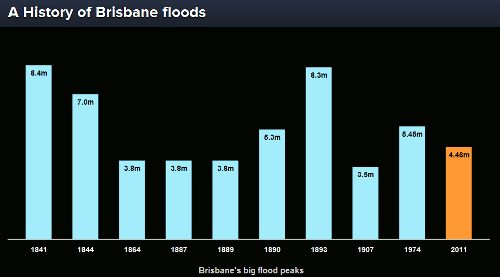
Source: http://www.abc.net.au/news/infographics/qld-floods/peaks.htm
January 16th, 2011 |
Categories: Extreme Weather Events, Natural Climate Change |
Definitely, particularly considering the very bad Queensland floods in the early 1930s and extreme floods of the late 1800s, the weather is definitely improving.
Our world is certainly changing; Antarctica, once a thriving forest is now a desolate ice land; the Adelaide hills, once a glacial wilderness is now a verdant scrub land; the Simpson Desert, once a forest of Acacia Peuce is now a glorious Aussie desert.
It is indisputable that the climate has changed endlessly through the millennia. The percentage of oxygen in the atmosphere needed to support life as we know it did not exist until the development of cyanobacteria and stromatolites between 2,300 million and 500 million years. Remnant living stromatolites in fact still exist in Shark Bay, Western Australia.
Only a religiously carbon-obsessed fanatic could seriously attribute those cyclic ice age-temperate climate changes to carbon dioxide. (Carbon dioxide is a colourless gas consisting of one atom of carbon with two atoms of oxygen).
Oxygen didn’t exist in a life supporting percentage of the earth’s atmosphere until the Earth’s developmental cycle referred to above.
Regards,
Nick Byrne
Alice Springs Australia
January 16th, 2011 |
Categories: Letters, Natural Climate Change |
Unsustainable cow manure
By Paul Driessen 21 Sep 2010
From http://townhall.com/columnists/PaulDriessen/2010/09/21/unsustainable_cow_manure/page/full/
Seek a sustainable future! Wind, solar and biofuels will ensure an eco-friendly, climate-protecting, planet-saving, sustainable inheritance for our children. Or so we are told by activists and politicians intent on enacting new renewable energy standards, mandates and subsidies during a lame duck session.
It may be useful to address some basic issues, before going further down the road to Renewable Utopia.
(more…)
January 13th, 2011 |
Categories: Alternate Energy, Solar Power, Wind Power |
The Carbon Sense Coalition today accused Western Governments of massive waste of community savings on frivolous climate “research” and alternative energy toys while neglecting the infrastructure needed to maintain sustainable societies in the face of an unknown climate future.
The Chairman of Carbon Sense, Mr Viv Forbes, said that none of the massive government climate spending has produced anything of long term use to the people paying their bills.
More, including:
- Magnifying National Disasters
- Was 2010 the Warmest year Ever?
- Tax on Hot Air
- Pictures worth a Thousand Words
- Enquiry on Wind Farms
- Follow us on Twitter
in the PDF: http://carbon-sense.com/wp-content/uploads/2011/01/adapt-or-die.pdf [266 KB]
January 10th, 2011 |
Categories: Natural Climate Change, Newsletters, Policy Issues, Warmer is Better |
Just a few US government bodies plan to spend US$2,481,000,000 on “Climate Research” in 2011. Not on roads, not on bridges, not on snow ploughs – on Climate PR supporting the world effort to tax and ration our use of energy.
See: http://climatequotes.com/2011/01/08/how-can-climate-scientists-spend-so-much-money/
At least A$800,000,000 is being spent annually in Australia on “Climate Research”. Not on flood-proof roads, airports and bridges, not on water storage, not on emergency helicopters – just wasted on chasing the climate will-o-the-wisp.
See: http://carbon-sense.com/2010/02/16/green-jobs-galore/
And the UK government plans to spend one thousand million pounds on carbon capture and burial. Not on reliable low cost energy; not on snow-proof airports – just wasted trying to bury natural aerial plant food.
See: http://climateresearchnews.com/2010/10/uk-spending-cuts-undermined-by-1-billion-plan-to-capture-and-bury-the-beneficial-harmless-gas-co2/
January 10th, 2011 |
Categories: Policy Issues |
Mr Steketee (Weekend Australian 8 Jan 2011) needs to tread carefully in the highly manipulated world of climate and weather statistics.
Quoting data from the UN World Meteorological Organisation is suspect because the WMO jointly created the IPCC, which is dedicated to proving that anthropogenic warming is happening regardless of evidence.
The British Met Office is in disarray for its conflicting and error-prone forecasts provided to the UK, while in New Zealand the national weather body abandoned their official temperature records because of manipulation of past data by the government agency. In Australia, the BOM is no different to many other data collection agencies around the world in selective manipulation of older raw data records downwards (i.e. cooler), thus making the overall trend appear warmer to the present. This effect is also achieved by closing of thousands of data stations around the world, most in the cooler regions, thus leading to a warming bias.
Recent high-quality ice core data from Greenland shows that of the past 10,500 years, 9,100 were warmer than 2010, with no relation to CO2, while the longest instrumental record in the world in central England shows that December 2010 was the second coldest December dating back to 1659. Australian raw data shows that we have warmed only 0.6oC since 1910, and Mr Steketee needs to look at the less alarmist bigger picture and to be better informed about the work of experts such as Professor Bob Carter.
Geoff Derrick
Sherwood Qld Australia
Addendum: Lord Monckton’s rebuttal of Steketee: http://wattsupwiththat.com/2011/01/09/monckton-skewers-steketee/
January 9th, 2011 |
Categories: Letters |
The warm peaks of the last 100 years were 1934, 1998 and 2010.
But where do they rank in a longer term list of warm years?
Of the past 10,500 years, 9,100 were warmer than 1934/1998/2010. Thus, regardless of which year (1934, 1998, or 2010) turns out to be the warmest of the past century, that year will rank number 9,099 in the long-term list.
The climate has been warming slowly since the Little Ice Age, but it has quite a ways to go yet before reaching the temperature levels that persisted for nearly all of the past 10,500 years.
It’s really much to do about nothing.
For a good summary of temperature trends see:
http://wattsupwiththat.com/2010/12/28/2010%E2%80%94where-does-it-fit-in-the-warmest-year-list/
January 9th, 2011 |
Categories: Forecasting, Natural Climate Change |
The Australian Bureau of Meteorology failed miserably to predict record breaking rainfall this spring. The B.O.M. forecast issued on 24th August 2010 read:
“The chance that the average spring maximum temperature will exceed the long-term median maximum temperature is above 60% over northern parts of Australia, as well as southeastern SA and all of Victoria and Tasmania. The national outlook for total rainfall over spring (September to November) is neutral for most of the country, with the odds favoring neither wetter nor drier conditions. The main exception to this is in southwest WA, where a wetter than normal spring is favoured. There is also a slight shift toward a wetter spring in northeastern NSW, along with a shift toward a drier spring in Tasmania and southern Victoria.”
I am well aware of the difference between weather and climate, but if the “experts” can’t predict correctly over such a short term, do you really have confidence in their long-term predictions?
John McLeish
Wodonga Australia
Sources:
http://www.bom.gov.au/climate/ahead/archive/temperature/20100824.shtml
http://www.bom.gov.au/climate/ahead/archive/rainfall/20100824.shtml
January 8th, 2011 |
Categories: Forecasting |
The role of methane in the atmosphere has been emphasized by the IPCC to the point that many governments regard methane as almost as important as carbon dioxide amongst the greenhouse gases. The result is that emissions from natural gas pipelines, coal seams and agricultural livestock have been included in schemes to limit the growth of greenhouse gas concentrations. Analysis of changes to atmospheric methane within the last one hundred years suggests that the annual increases from 1930 to 1990 were due to losses from the production, transmission and distribution of natural gas that have now been reduced. Measurements over the last fifteen years show only natural variability. The data provide no justification for any attempts to reduce methane from industrial or agricultural activity.
For a full report by Tom Quirk, Twentieth Century Sources of Methane in the Atmosphere, see: http://carbon-sense.com/wp-content/uploads/2011/01/quirk-methane-in-atmosphere.pdf [PDF, 223 KB]
January 8th, 2011 |
Categories: CO2 Greenhouse Science |
Predicting the weather — especially a decade or more in advance — is unbelievably challenging. What’s the track record of those most worried about global warming? Decades ago, what did prominent scientists think the environment would be like in 2010? FoxNews.com has compiled eight of the most egregiously mistaken predictions, and asked the predictors to reflect on what really happened.
Read Eight Botched Environmental Forecasts at FoxNews:
http://www.foxnews.com/scitech/2010/12/30/botched-environmental-forecasts/
January 8th, 2011 |
Categories: Forecasting |
« Previous Page — Next Page »
|


 RSS
RSS